
Carrie Underwood’s Dolly Parton tribute sparks online debate over her appearance and performance.
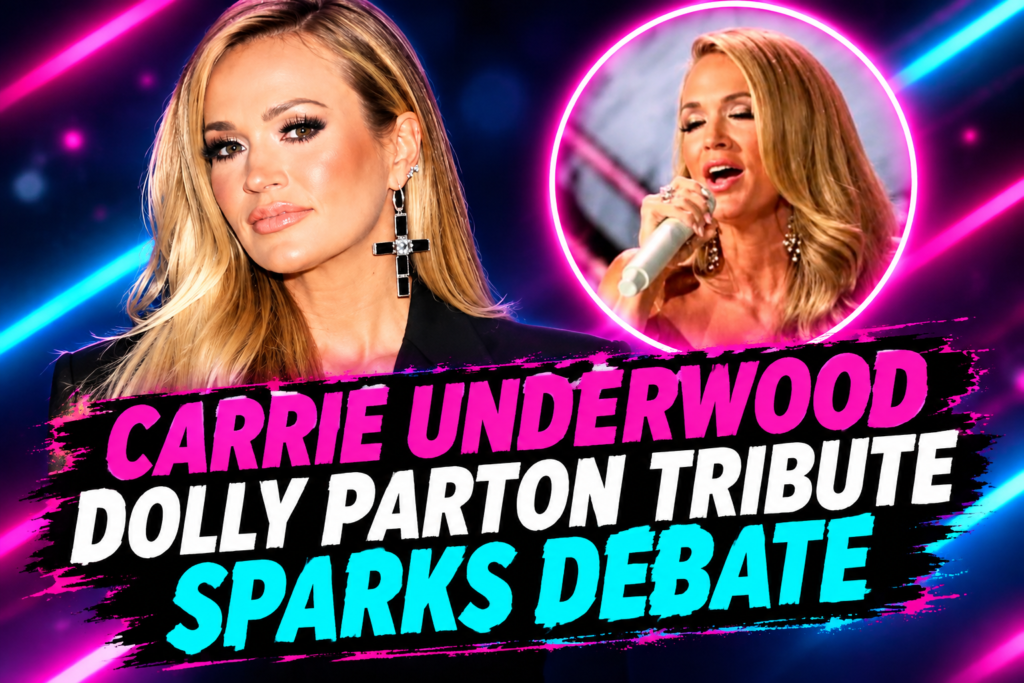
The Carrie Underwood Dolly Parton tribute has become a major topic of online conversation after the country music superstar appeared at a special celebration honoring Dolly Parton’s legendary musical career in Nashville. Although Underwood’s performance attracted attention, much of the online discussion focused on her appearance, makeup, bronzed complexion, and previous political controversies.
The event, titled CMA Presents I Will Always Love You: A Celebration of Dolly Parton, brought together several artists to celebrate Parton’s remarkable contribution to country music. Underwood performed the beloved song “I Will Always Love You” as the show’s closing act, delivering a performance that received a standing ovation. People
However, the reaction to the singer was mixed. While many viewers appreciated her vocal performance and glamorous appearance, others took to social media to criticize her makeup and spray tan. Some commenters also brought up her participation in Donald Trump’s 2025 presidential inauguration, turning an entertainment event into a broader discussion about celebrity image, politics, and public expectations.
Carrie Underwood Faces Criticism After Dolly Parton Tribute
Carrie Underwood arrived at the Nashville celebration wearing a strapless pale pink-and-white gown featuring floral embroidery and sparkling details. Her blonde hair was styled in loose waves, while her makeup and overall appearance attracted considerable attention online.
According to reports, some social media users described her appearance as “frightening,” while others made jokes about her bronzed complexion. The phrase “Mar-a-Lago face” also appeared in online discussions, reflecting critics’ opinions about what they considered an overly polished or artificial beauty look.
The comments quickly became a talking point among entertainment followers. Instead of focusing exclusively on Underwood’s musical contribution, many conversations shifted toward her styling choices and whether her appearance had changed.
Not everyone agreed with the negative reactions. Some people defended the singer, arguing that public figures should not have to face personal attacks simply because of their makeup, complexion, or fashion choices.
The disagreement highlights how quickly a celebrity’s appearance can become a trending topic. A single photograph from a major event can generate thousands of opinions, with viewers interpreting the same image in very different ways.
It is important to remember that comments posted online represent individual opinions rather than a universal judgment. A person’s makeup, lighting, styling, and choice of clothing can influence how they appear in photographs and on television.
Why the Singer’s Spray Tan Became a Talking Point
One of the most discussed aspects of the Carrie Underwood Dolly Parton tribute was the singer’s bronzed complexion. Some online commenters joked about her spray tan, while others questioned the overall appearance of her makeup.
Spray tanning and bronzing products are common in the entertainment industry. Performers frequently work with professional makeup artists who select products according to stage lighting, camera settings, costumes, and the desired appearance.
Strong stage lights can affect how makeup and skin tones appear on camera. Photography, color correction, and differences between indoor and outdoor lighting can also influence the final image viewers see online.
That does not mean every criticism of a celebrity’s appearance is justified. Beauty preferences differ, and makeup that one viewer considers glamorous may seem excessive to someone else.
In Underwood’s case, the online reaction demonstrates how closely audiences examine celebrities during high-profile appearances. Even a carefully planned outfit and professional styling can become subjects of debate once photographs circulate across social media.
There is also a difference between commenting on a public appearance and making assumptions about someone’s personal choices. Without confirmation from the individual concerned, speculation about specific cosmetic treatments or procedures should not be presented as established fact.
Ultimately, the discussion surrounding Underwood’s spray tan reflects broader conversations about beauty standards, celebrity culture, and the pressure performers face to maintain a particular public image.
What Does “Mar-a-Lago Face” Mean?
The phrase “Mar-a-Lago face” became another recurring expression in online reactions to Underwood’s appearance. In celebrity commentary, the label is generally used to describe a highly polished aesthetic associated by some observers with prominent figures in conservative political circles.
Depending on the person using the phrase, it may refer to heavily bronzed skin, defined facial contours, prominent makeup, full-looking lips, or a particularly sculpted appearance.
However, the term is subjective and is not a medical diagnosis. It is a cultural expression used in online conversations, often in a critical or mocking way.
Its use in discussions about Underwood shows how quickly beauty commentary can overlap with political identity. Rather than simply describing a dress or hairstyle, some viewers use appearance-related labels to express broader feelings about a celebrity’s public image.
There is no verified basis for treating social media comments as proof that Underwood has undergone any particular cosmetic procedure. Facial appearance can be influenced by makeup, lighting, photography, aging, styling, and many other factors.
For that reason, it is more accurate to describe the controversy as speculation about her appearance than to claim that a specific procedure caused it.
The debate also raises a wider question about how society discusses beauty. Celebrities regularly face pressure to look youthful, polished, and camera-ready, yet they can also be criticized when their appearance seems too carefully maintained.
This creates an environment in which almost any styling decision can attract attention, regardless of the performer’s actual intentions.
Political Controversy Returns to the Spotlight
The conversation about Underwood’s appearance was not the only reason her participation in the tribute attracted attention. Some critics also referenced her decision to perform at Donald Trump’s presidential inauguration in January 2025.
Underwood agreed to sing “America the Beautiful” at the ceremony. When the planned musical accompaniment encountered a technical problem, she continued singing without it.
At the time, Underwood explained that she loved her country and felt honored to have been asked to perform. She also emphasized the importance of unity and looking toward the future.
Her decision nevertheless generated differing reactions. Some people praised her willingness to participate in a historic national event, while others criticized the choice because of their political views.
Those disagreements resurfaced during the Dolly Parton celebration, with some social media users questioning whether Underwood’s political associations were compatible with their understanding of Parton’s values.
It is important to distinguish between a singer’s documented public actions and assumptions about their private beliefs. Performing at a presidential inauguration is a public event, but it does not automatically establish every political position a performer may hold.
Likewise, online criticism does not necessarily represent the views of all fans.
The renewed debate illustrates how political controversies can follow entertainers into unrelated professional settings. An appearance intended to celebrate music can become another opportunity for audiences to revisit disagreements that began years earlier.
Carrie Underwood’s Performance Remains a Major Part of the Story
Despite the controversy, Underwood’s musical contribution remained an important part of the Nashville event.
The country star closed the program with “I Will Always Love You,” one of Dolly Parton’s most recognizable songs. Her performance received a standing ovation, and Reba McEntire and Brad Paisley joined her for the final chorus, according to published coverage.
The song holds a special place in country music history. Parton wrote it as a farewell to her professional relationship with Porter Wagoner, who had helped establish her career in the music industry.
Parton’s original recording became widely celebrated, while Whitney Houston’s later version introduced the song to another generation of listeners and became a global hit.
Performing such a familiar song at a tribute event presents a significant challenge. Audiences often arrive with strong emotional connections to the original recording, meaning that any new interpretation is likely to invite comparisons.
Underwood’s decision to close the program placed her performance at the center of the celebration. The standing ovation indicated that the appearance included a positive audience response, even as online discussions became divided.
For country music fans, the performance offered an opportunity to revisit a song that has remained influential across generations.
The contrast between the reception of the live performance and the criticism circulating online also illustrates how different audiences evaluate entertainment. People watching the show may focus on vocal delivery and emotional impact, while social media users examining photographs may concentrate on styling and appearance.
Both conversations can happen simultaneously, but neither should be mistaken for the complete picture of an event.
Dolly Parton’s Influence on Country Music
Dolly Parton’s influence extends far beyond a collection of hit songs. Over decades, she has become one of country music’s most recognizable figures, admired for her songwriting, distinctive voice, stage presence, and ability to connect with audiences.
Her musical catalog includes songs that explore love, heartbreak, family, ambition, and personal independence. Many have been covered by performers working across different genres, demonstrating the lasting appeal of her songwriting.
Parton has also built a public reputation through entertainment projects, business ventures, and charitable initiatives. Her Imagination Library program, which provides books to young children, is one example of her efforts to support literacy.
A tribute celebrating her career therefore represents more than an ordinary concert. It brings together artists and audiences who have been influenced by her work, while introducing her music to listeners who may be discovering it for the first time.
Underwood’s participation fits into this broader musical tradition. She has frequently expressed admiration for established artists, and performing Parton’s signature song provided an opportunity to acknowledge an influential figure in country music.
Although the surrounding online controversy attracted attention, the event’s central purpose remained the celebration of Parton’s musical legacy.
Social Media Reactions Reveal the Pressure of Celebrity Culture
The Carrie Underwood Dolly Parton tribute controversy offers another example of how social media has changed the way audiences respond to celebrities.
In the past, discussions about a performer’s appearance might have remained within entertainment magazines or television commentary. Today, photographs and short video clips can circulate around the world within minutes.
Users can immediately publish opinions, compare images, and join conversations with people who share their interests. This creates opportunities for fan communities to celebrate performances, but it also makes public figures vulnerable to harsh personal criticism.
Appearance-related comments often spread because they provoke strong reactions. Some people find them entertaining, while others consider them unnecessary or cruel.
The speed of online discussion can also remove context. A photograph may capture a single moment, but viewers may use it to draw broader conclusions about a person’s lifestyle, personality, or political identity.
This does not mean celebrities should be exempt from criticism. Public performances and professional decisions naturally invite discussion. However, there is a meaningful difference between evaluating a performance and making unsupported claims about someone’s body or personal life.
The debate surrounding Underwood demonstrates why context and responsible reporting matter. Readers deserve to understand what happened, what people actually said, and which details remain unverified.
For audiences, it is equally important to remember that a trending hashtag or a collection of critical comments does not necessarily reflect the opinion of the wider public.
What Happens Next for Carrie Underwood?
The recent attention may continue to generate discussion among country music fans, particularly as photographs and clips from the tribute circulate online.
However, it would be premature to assume that the controversy will have a lasting impact on Underwood’s career. Online reactions can be intense but short-lived, and a single public appearance does not determine an artist’s long-term reputation.
Underwood remains widely recognized for her music, live performances, and years of work in country entertainment. Her appearance at the Dolly Parton celebration also placed her alongside other artists participating in a program dedicated to one of the genre’s most influential performers.
Whether people agree with the criticism or defend the singer, the discussion highlights the complicated relationship between celebrity, public image, politics, and entertainment.
The most useful way to assess the event is to consider its different elements separately: the musical tribute, the audience response, the appearance-related comments, and the political debate.
Doing so allows readers to understand the controversy without assuming that every online allegation is true.
Final Thoughts
The Carrie Underwood Dolly Parton tribute generated widespread discussion because it brought together a celebrated country music performance and a highly visible debate about celebrity appearance and politics.
While some social media users criticized Underwood’s makeup, spray tan, and overall look, others defended her against personal attacks. Her participation also prompted renewed discussion about her 2025 inauguration performance.
At the same time, her closing rendition of “I Will Always Love You” received a standing ovation, keeping the musical side of the event firmly in the conversation.
Ultimately, the story demonstrates how quickly a celebrity appearance can become a wider cultural debate. The online reaction may continue, but the event also offers an opportunity to appreciate the music, recognize the influence of Dolly Parton, and approach celebrity news with a balanced perspective.
Readers can disagree about fashion, makeup, or politics while still recognizing the importance of accurate reporting and respectful discussion. That balance is especially valuable when a public figure’s appearance becomes the focus of a viral story.
Frequently Asked Questions
1. Why is Carrie Underwood trending after the Dolly Parton tribute?
Underwood attracted attention after attending a Nashville tribute celebrating Dolly Parton’s music. Online discussions focused on her appearance, makeup, spray tan, and political associations, alongside reactions to her performance.
2. What did Carrie Underwood sing at the tribute?
She performed “I Will Always Love You” as the closing act of the celebration. Published reports said her performance received a standing ovation.
3. Why are people using the phrase “Mar-a-Lago face”?
Some social media users use the expression to criticize a highly polished appearance associated with certain public figures. It is a subjective label, not a medical diagnosis or proof of cosmetic procedures.
4. Why did the controversy involve politics?
Some commenters revisited Underwood’s decision to perform at Donald Trump’s 2025 presidential inauguration. Their political opinions became part of the discussion surrounding her participation in the tribute.
5. Has Carrie Underwood confirmed having cosmetic procedures?
The online comments discussed in media coverage do not establish that she has undergone specific cosmetic procedures. Claims about individual treatments should not be treated as facts without reliable confirmation.