

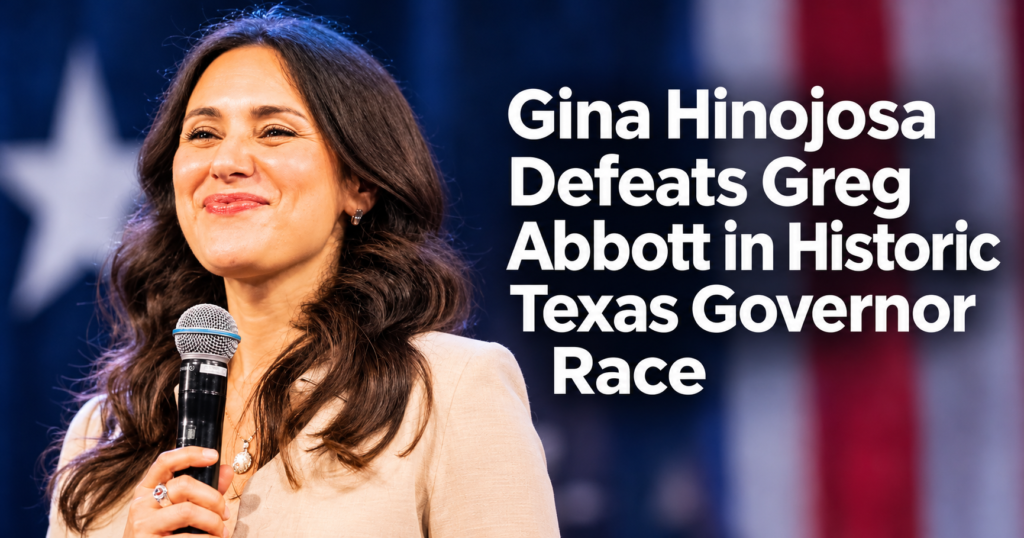
Gina Hinojosa is featured in an election news graphic about the 2026 Texas governor race against Republican incumbent Greg Abbott.
In one of the most remarkable political developments of the 2026 United States midterm elections, Democratic candidate Gina Hinojosa has defeated longtime Republican Governor Greg Abbott in the Texas gubernatorial race, delivering a historic victory that could reshape the state’s political future.
Gina Hinojosa Defeats Greg Abbott in Historic Texas Governor Race, ending more than three decades of Republican control of the governor’s office and becoming the first Latina elected to lead Texas.
The election, held on November 3, 2026, attracted national attention because Texas has traditionally been one of the Republican Party’s most important political strongholds.
Abbott, who first became governor in 2015, was seeking a fourth consecutive term. Instead, he faced a surprising defeat against Hinojosa, a Democratic state legislator who entered the campaign with significantly fewer financial resources and lower statewide name recognition.
The Associated Press and other major news organizations reported Hinojosa’s victory, confirming one of the biggest political upsets of the election cycle.
Her success signals an important change in Texas politics while raising new questions about the state’s political direction.
Gina Hinojosa Defeats Greg Abbott in Stunning Election Upset
The 2026 Texas governor election became a closely watched contest as both candidates presented sharply different visions for the state’s future.
Greg Abbott campaigned on his experience leading Texas, emphasizing conservative governance, border security, economic growth, and education policies.
Gina Hinojosa challenged his leadership by focusing on affordability, public education, government accountability, and the financial pressures affecting ordinary Texans.
Although Abbott entered the race with major advantages in fundraising and political organization, Hinojosa gained support among voters seeking changes in state leadership.
As election results arrived on November 3, the Democratic candidate established a lead that ultimately produced her historic victory.
According to election results reported by Decision Desk HQ on November 4, Hinojosa received approximately 52.8% of the vote, compared with Abbott’s 45.7%.
Those figures represented a substantial victory in a state where Republicans had dominated statewide elections for decades.
Abbott subsequently conceded the election and indicated that he would assist with the transition to the incoming administration.
The result immediately became a national political headline.
Who Is Gina Hinojosa?
Gina Hinojosa is a Democratic politician and Texas state representative who gained statewide recognition through her campaign for governor.
Before entering the gubernatorial race, she represented an Austin-area district in the Texas House of Representatives.
Her political career has focused heavily on public education, government policy, and issues affecting working families.
Hinojosa developed a reputation as a strong advocate for public schools and frequently challenged Republican education proposals.
During her campaign, she argued that Texas needed leadership more focused on the everyday challenges facing residents.
Her message emphasized the cost of living, educational opportunities, and accountability in government.
Unlike some statewide candidates who begin with extensive political networks and major fundraising advantages, Hinojosa initially faced considerable obstacles.
Abbott had access to a significantly larger campaign operation and entered the election with substantial financial resources.
Nevertheless, Hinojosa successfully introduced herself to voters across Texas.
Her victory has now elevated her from state legislator to governor-elect of one of America’s largest and most influential states.
Texas Elects Its First Latina Governor
One of the most significant aspects of Hinojosa’s victory is its historic importance.
She is set to become the first Latina governor in Texas history.
Her election also marks the first time a Democrat has won the Texas governorship since Ann Richards, who served from 1991 until 1995.
For more than three decades, Republican governors controlled the state’s executive branch.
Hinojosa’s victory brings that period to an end.
The historical significance extends beyond party politics.
Texas has a large Hispanic population, and the election of its first Latina governor represents an important milestone in political representation.
Her success demonstrates how the state’s leadership is evolving alongside its population and electorate.
However, winning the election is only the beginning of the challenges she will face.
Hinojosa must now prepare to govern a politically diverse state with complicated economic, educational, and legislative priorities.
Her administration’s ability to turn campaign promises into policy will be closely examined.
Why Did Greg Abbott Lose the Texas Governor Race?
Greg Abbott’s defeat represents an extraordinary political development because he had remained a dominant figure in Texas Republican politics for many years.
Before becoming governor, Abbott served as the state’s attorney general and as a justice on the Texas Supreme Court.
His long political career gave him extensive experience, statewide recognition, and a well-established support network.
As governor, Abbott became nationally known for his positions on immigration, border enforcement, abortion restrictions, education, and conservative social policies.
His administration also promoted business investment and economic development.
Supporters credited him with maintaining a favorable environment for businesses and defending conservative priorities.
Critics, however, challenged his positions on public school funding, healthcare, reproductive rights, and other issues.
During the 2026 campaign, Hinojosa attempted to connect these policy disagreements to the financial concerns of Texas families.
She placed particular emphasis on the affordability of everyday necessities and the condition of public schools.
Her campaign also opposed Abbott’s approach to private school vouchers.
The election results suggest that enough voters were dissatisfied with the existing leadership to support a different direction.
However, the final outcome cannot be explained by one issue alone.
Economic concerns, turnout patterns, candidate messaging, and the broader national political environment may all have influenced the result.
Public Education Became a Major Election Issue
Education was one of the central issues separating Hinojosa and Abbott.
During his time as governor, Abbott supported measures designed to expand alternatives to traditional public schools.
One of the most controversial areas involved private school voucher programs.
Supporters argued that allowing families to use public funds for alternative educational options would increase parental choice.
Opponents maintained that such programs could weaken traditional public schools by redirecting resources away from existing education systems.
Hinojosa made opposition to school vouchers an important part of her campaign.
She argued that public schools deserved stronger support and greater attention from state leaders.
Her message appealed to voters concerned about teacher shortages, classroom resources, and educational opportunities.
Texas has a large and diverse public education system, making school funding an issue with consequences for millions of families.
As governor-elect, Hinojosa faces the challenge of translating her campaign promises into workable policy.
Any substantial changes will depend partly on the composition and cooperation of the Texas Legislature.
Even with a gubernatorial victory, political disagreements over education are likely to continue.
Cost of Living and Economic Concerns Influenced the Campaign
Another major theme of the election was affordability.
Across Texas, families have experienced concerns about housing costs, property taxes, utility expenses, and other household financial pressures.
Hinojosa attempted to connect with voters by presenting these challenges as central priorities for state government.
She argued that political leaders should pay greater attention to the financial realities facing residents.
Her campaign included a proposal for a one-time payment of $1,500 to eligible Texans using money from the state’s emergency savings.
The proposal attracted attention as part of her broader affordability message.
However, the payment remains a campaign proposal rather than an approved government benefit.
Implementing such a policy would require additional decisions involving state finances and legislative authority.
Abbott’s campaign emphasized Texas’ economic performance and its reputation as a business-friendly state.
The election therefore presented voters with contrasting perspectives on economic management.
Hinojosa’s victory indicates that her message persuaded enough voters to secure statewide support.
Whether her administration can deliver measurable improvements in affordability will become an important test of her leadership.
How the Election Could Change Texas Politics
Texas has long played a major role in national Republican politics.
Its large population, economy, and Electoral College representation make it an especially influential state.
For decades, Republicans maintained a strong advantage in statewide elections.
Hinojosa’s victory disrupts that established political pattern.
The result may encourage Democrats to invest additional resources in Texas during future election cycles.
It could also lead Republicans to reassess their strategies for reaching suburban voters, younger residents, and Hispanic communities.
Nevertheless, one gubernatorial election does not automatically establish a permanent change in party dominance.
Future elections will determine whether the 2026 result represents a lasting political realignment or a particularly significant victory under unique circumstances.
Political organizations from both major parties are likely to study the voting patterns carefully.
The outcome also draws attention to changes in the state’s electorate.
Population growth, migration, economic conditions, and shifts in voter priorities have transformed Texas over time.
How these factors influence future elections remains an important question.
What Did Greg Abbott Say After Losing?
Following the election, Greg Abbott conceded defeat to Gina Hinojosa.
According to post-election reporting, the outgoing governor indicated his willingness to assist with the transfer of power.
His concession brought an end to his effort to win a fourth term.
Abbott has served as Texas governor since January 2015, making him one of the state’s most prominent modern political figures.
His years in office included major debates over immigration, public education, public health, and state-federal relations.
Although he lost the election, Abbott’s political influence and the policies developed during his administration are likely to remain important subjects in Texas politics.
The transition will require cooperation between the outgoing and incoming administrations.
Hinojosa is expected to take office in January 2027.
Until then, Abbott remains governor and continues to carry out the responsibilities of the office.
What Happens Next for Gina Hinojosa?
Winning the governorship is a significant achievement, but Hinojosa will face complex challenges when she assumes office.
Texas has a major economy, extensive transportation infrastructure, a large public education system, and substantial energy interests.
The incoming governor will also inherit disagreements over immigration policy, government spending, healthcare, and environmental concerns.
Education reform and affordability are expected to receive particular attention because they were central to her campaign.
However, the governor cannot implement every proposal independently.
Major legislation often requires cooperation with lawmakers, including those who may disagree with her political agenda.
The governor does possess important executive powers, including the ability to veto legislation and appoint certain state officials.
These responsibilities will allow Hinojosa to influence government policy even where legislative compromises are necessary.
Her performance during the first year will provide an early indication of how effectively she can manage the transition from campaigning to governing.
Supporters will expect progress on the promises that helped secure her election.
Opponents will examine the cost, effectiveness, and consequences of her proposed policies.
National Political Reactions to the Texas Election
Hinojosa’s victory attracted attention beyond Texas because of the state’s national importance.
The defeat of a three-term Republican governor represents an important development in the broader 2026 midterm election results.
Democrats celebrated the breakthrough as evidence that their candidates could compete successfully in states traditionally considered Republican strongholds.
Republicans, meanwhile, face questions about turnout, campaign strategy, and voter dissatisfaction.
Political analysts will likely examine the outcome alongside other significant election results across the country.
The Texas race also demonstrates why local concerns can influence elections with major national implications.
Issues such as schools, housing costs, government accountability, and economic security can shape voter decisions regardless of broader partisan traditions.
Still, the result should be evaluated in context rather than treated as proof that all future Texas elections will produce similar outcomes.
Both major parties will continue competing for support in the state.
Final Thoughts
Gina Hinojosa Defeats Greg Abbott in Historic Texas Governor Race, delivering one of the most significant election results of 2026.
Her victory ends more than three decades of Republican control of the governor’s office and makes her the first Latina elected to lead Texas.
The result also ends Greg Abbott’s attempt to secure a fourth term after more than a decade as governor.
Hinojosa’s campaign emphasized public education, affordability, and government accountability, helping her secure support in an election that attracted national attention.
Now, the focus shifts from the campaign to the responsibilities of governing.
As Texas prepares for a new administration in January 2027, the decisions made by its incoming governor will determine how the historic election translates into policies affecting residents.
The 2026 Texas gubernatorial race will be remembered as a major political upset and a milestone in the state’s history.