
Zelenskyy and Melania Trump spark online debate over their English-language skills and fluency.
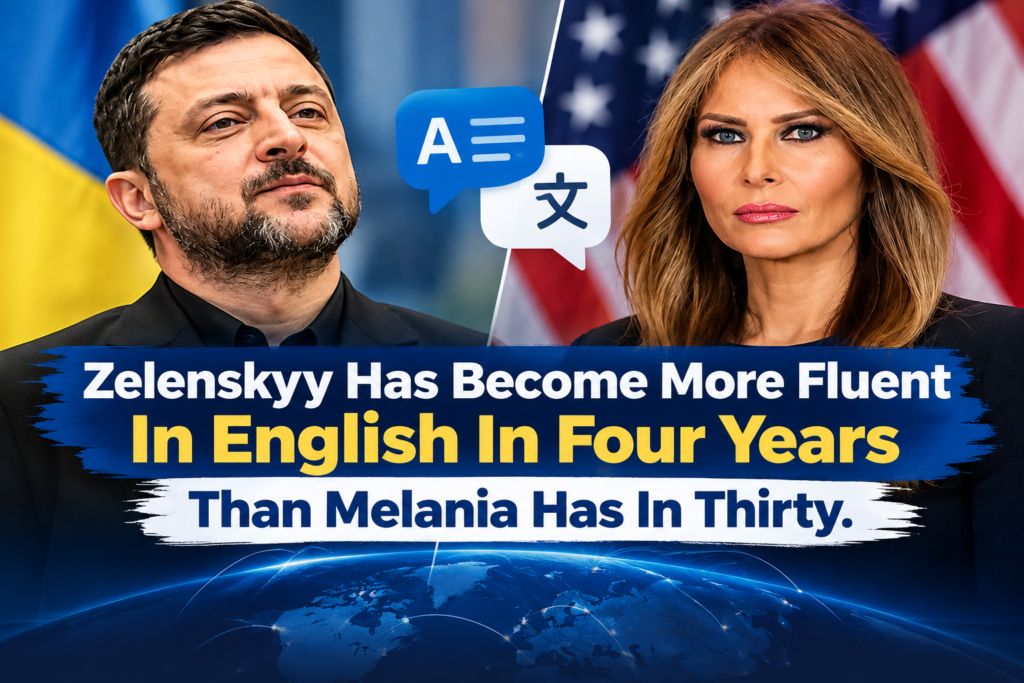
Volodymyr Zelenskyy’s growing confidence in English has become a topic of online discussion, with some social media users comparing his progress with Melania Trump’s English-speaking abilities. The comparison has attracted attention because both figures are internationally recognized and regularly appear in front of global audiences. However, the headline reflects an opinion rather than a verified measurement of either person’s language skills. Zelenskyy Has Become More Fluent In English In Four Years Than Melania Has In Thirty.
Zelenskyy, the president of Ukraine, has increasingly taken part in international interviews and conversations where English plays an important role. His ability to communicate directly with journalists and political leaders has become especially noticeable during Russia’s full-scale invasion of Ukraine, when international diplomacy and public communication have been central to his presidency.
Melania Trump, meanwhile, grew up in Slovenia and developed an international career in modeling before moving to the United States in the 1990s. She speaks multiple languages, including English, and has appeared publicly in English for decades.
Although the comparison makes for a provocative headline, there is no established test or reliable evidence showing that Zelenskyy has become more fluent in four years than Melania Trump has in thirty. What can be examined is how both public figures use English, how their backgrounds differ, and why their language abilities have become a subject of public conversation.
Zelenskyy’s Growing Use of English in International Interviews
Before entering politics, Zelenskyy built a career in Ukrainian entertainment as an actor, comedian, producer, and television personality. His public identity was shaped largely by his work in Ukrainian-language entertainment rather than by English-language productions.
After becoming president of Ukraine in 2019, he increasingly faced the challenge of communicating with international audiences. His responsibilities expanded dramatically following Russia’s full-scale invasion in February 2022.
International interviews, speeches, press conferences, and meetings with foreign leaders became essential parts of his work. These appearances required him to explain Ukraine’s position, discuss the war, appeal for international assistance, and respond to questions from journalists around the world.
English is widely used in international diplomacy and journalism, so speaking it directly can help a leader communicate with a global audience. However, using a second language in high-pressure political situations is not the same as speaking it in a relaxed conversation.
A president must communicate complex ideas accurately, respond to unexpected questions, and avoid misunderstandings that could affect diplomatic relationships. Interpreters remain important in these settings, even when a leader can speak some English independently.
Zelenskyy’s public English-language appearances have allowed audiences to observe his communication skills over time. They have also prompted discussions about how much his spoken English has improved since the beginning of the war.
What Interviewers Have Said About Zelenskyy’s English
One notable example came in September 2025, when Zelenskyy appeared on The Axios Show. According to Axios, the Ukrainian president agreed to conduct the interview in English at the last moment. The publication noted that, despite his own modest comments about his fluency, his points came through clearly.
The interview offered an example of Zelenskyy communicating directly in English about difficult political subjects, including the war and his country’s future.
His ability to take part in such conversations matters because interviews often require more than prepared statements. Interviewers can change direction, ask follow-up questions, or introduce subjects that require immediate responses.
Speaking directly can also allow a public figure to convey emotion through tone, pauses, and emphasis without relying entirely on an interpreter. Nevertheless, an interview does not provide a standardized measurement of language proficiency.
The Axios interview supports the observation that Zelenskyy has used English in demanding public settings. It does not, by itself, prove the exact amount of progress he has made or establish that he is more fluent than another multilingual public figure.
Language proficiency involves several abilities, including listening comprehension, grammar, vocabulary, pronunciation, reading, writing, and spontaneous conversation. A person may be highly effective in interviews without having identical proficiency across every skill.
Why English Matters for Ukraine’s President
For Zelenskyy, communicating with international audiences is closely connected to his responsibilities as head of state.
Ukraine depends on diplomatic relationships with countries around the world. Discussions involving military assistance, economic support, sanctions, humanitarian needs, and potential peace negotiations require consistent communication between governments.
English can help bridge linguistic differences during international media appearances and meetings. It also allows messages from Ukrainian leadership to reach viewers directly in countries where English-language reporting is widely consumed.
However, effective communication does not depend on language fluency alone. A leader must also understand the subject, organize arguments, answer questions carefully, and communicate under pressure.
Zelenskyy’s background in television and performance may also influence his public communication style. Years of working in entertainment can develop skills such as speaking to an audience, maintaining composure, and conveying emotion. These skills are different from language proficiency, although they can help someone communicate effectively in a second language.
His public appearances therefore reflect a combination of political experience, communication skills, preparation, and developing English ability.
Melania Trump’s Multilingual Background
Melania Trump has a different linguistic and professional background. Born in Slovenia, she grew up speaking Slovenian before pursuing an international modeling career in Europe and later the United States.
Her work took her into international environments where communication across languages could be useful. She moved to New York in 1996 and continued working in the fashion industry before marrying Donald Trump in 2005.
Biographical accounts have described her as multilingual. The Miller Center at the University of Virginia notes that English was not her first language and lists several languages she speaks, including Slovenian, Italian, German, French, and English.
CNN’s published biographical summary has also listed English among the languages she speaks, alongside several European languages.
These details are important because they provide context for understanding her language experience. Melania Trump has spent decades in international professional and public environments, but the length of time a person has lived in an English-speaking country does not automatically determine their level of fluency.
People acquire and maintain languages in different ways. Their progress can depend on how frequently they use a language, whether they receive formal instruction, the situations in which they communicate, and their personal learning preferences.
It would therefore be misleading to conclude that someone has made little progress simply because their accent remains noticeable or because they speak less frequently in public.
Does Speaking for Longer Mean Someone Is More Fluent?
The comparison between Zelenskyy and Melania Trump raises a broader question about how people judge language ability.
Many people evaluate fluency based on what they hear during interviews, speeches, or public appearances. They may notice pronunciation, pauses, vocabulary, grammatical mistakes, or the ease with which a speaker answers unexpected questions.
These observations can provide useful impressions, but they are not enough to produce a definitive ranking.
A person who speaks English regularly in unscripted interviews may appear more comfortable than someone who primarily uses prepared remarks. Another person may speak less frequently but possess excellent reading comprehension, writing skills, and vocabulary.
Accent is also an unreliable measure of overall proficiency. Someone can have a strong accent and still communicate with considerable accuracy and fluency. Conversely, a familiar-sounding accent does not necessarily mean a speaker has advanced command of grammar or complex vocabulary.
The most reliable comparisons would involve consistent assessment criteria and comparable evidence from both individuals. Without that information, claims about who is more fluent remain subjective.
The same principle applies to language learning in everyday life. Progress is best understood by looking at what a person can understand and communicate, rather than judging them only by how they sound.
Why Their Language Skills Became a Social Media Topic
Public figures are frequently compared online, particularly when they have international profiles or connections to political leadership.
Short video clips can make language comparisons especially tempting. One person may deliver a long interview in English, while another appears in a brief clip with a noticeable accent or a limited response. Viewers may interpret the difference as evidence of a major gap in ability.
However, short clips do not always provide the full context. A speaker may be tired, answering a difficult question, choosing words carefully, or speaking in a formal setting. Edited footage can also omit parts of a conversation that would change a viewer’s impression.
Zelenskyy and Melania Trump also communicate in very different professional circumstances. Zelenskyy frequently addresses international political issues as president of a country at war. Melania Trump’s public appearances have involved a different mix of private, charitable, fashion, and first-lady responsibilities.
Their opportunities and reasons for speaking English are therefore not identical.
That difference does not mean their language skills cannot be discussed. It means the discussion should distinguish observable examples from assumptions about their overall proficiency.
A viral headline can start an interesting conversation, but it should not replace a careful assessment of the evidence.
The Difference Between Fluency and Effective Communication
Fluency is often treated as a single quality, but language proficiency has several dimensions.
Conversational fluency generally involves communicating ideas without excessive difficulty. More advanced proficiency may include understanding complicated arguments, recognizing subtle meanings, using idiomatic expressions, and adapting language to different situations.
Professional communication adds further demands. Diplomats and political leaders must often discuss technical subjects, respond to difficult questions, and communicate ideas that may have important consequences.
A speaker can be effective without sounding like a native speaker. Clear structure, appropriate vocabulary, good listening skills, and the ability to explain complicated ideas are often more important than eliminating every accent or grammatical imperfection.
This is relevant when evaluating Zelenskyy’s English interviews. His ability to communicate his position directly is meaningful, even if some aspects of his English differ from those of a native speaker.
The same standard should apply to Melania Trump. Her multilingual background and years of public appearances are relevant context, but neither her accent nor her frequency of speaking publicly establishes a precise proficiency score.
Without comparable assessments, it is not possible to state scientifically that one has achieved greater fluency over a particular number of years.
How Adults Improve Their Second-Language Skills
The discussion also highlights an important point about language learning: adults can continue improving their speaking abilities long after they first encounter a language.
Regular exposure helps learners become more familiar with vocabulary, sentence structures, pronunciation, and common expressions. Speaking with other people provides opportunities to practice retrieving words quickly and responding naturally.
Work can create particularly strong incentives to improve. Someone who frequently gives interviews, attends meetings, or speaks to international audiences may develop greater confidence because those activities require repeated practice.
Feedback can also help. Learners who receive corrections, review their mistakes, and practice challenging conversations can gradually improve their accuracy and confidence.
Nevertheless, language learning does not follow a fixed timeline. Some people make rapid progress in conversational situations, while others need more time to feel comfortable speaking. Existing knowledge, motivation, available instruction, and opportunities for practice all affect the process.
Zelenskyy’s international responsibilities have created many situations in which he can use English publicly. Melania Trump’s career has also involved international environments and multilingual communication.
Their experiences illustrate different relationships with language, but they do not establish a simple contest with a measurable winner.
What We Can Fairly Conclude
The headline comparing Zelenskyy’s English progress with Melania Trump’s language skills is attention-grabbing, but the available information supports a more careful conclusion.
Zelenskyy has demonstrated that he can participate in English-language interviews and communicate important political messages to international audiences. Reporting from Axios in September 2025 described an interview in which he spoke English and made his points clearly.
Melania Trump has a multilingual background and has been publicly described as speaking several languages, including English. Her international modeling career and decades in the United States provide context for her experience, but they do not establish an objective proficiency score.
There is no reliable, directly comparable evidence proving that Zelenskyy has become more fluent in English in four years than Melania Trump has in thirty. Such a conclusion would require more than comparing selected interviews or listening for differences in accent.
What can be said is that both figures operate in international public life and have used English in different ways. Their experiences demonstrate how language can serve as a tool for communication, professional opportunity, and public engagement.
Final Thoughts
Volodymyr Zelenskyy’s English-language interviews have attracted attention as he continues communicating with international audiences about Ukraine’s future. Melania Trump, meanwhile, has her own multilingual history, shaped by her upbringing in Slovenia and her international career.
The comparison between them has generated discussion because language skills are easy to notice but difficult to evaluate fairly from short public appearances.
Rather than treating the headline as an established fact, readers should consider the context, the available evidence, and the difference between personal impressions and measured proficiency.
Ultimately, the most useful lesson is that language learning is individual. Progress depends on practice, opportunity, experience, and the particular skills someone needs to develop. Both public figures offer examples of communication across languages, but a definitive ranking of their English fluency cannot be established from the available information alone.