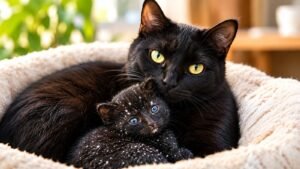


A blind cat reportedly survived the aftermath of Hurricane Katrina by following the sound of a dog’s collar.
Hurricane Katrina was one of the most devastating natural disasters in American history, leaving behind destroyed homes, displaced families, and countless animals in desperate need of help. Among the many heartbreaking stories to emerge from the disaster was one involving an unlikely pair: a dog and a cat whose bond helped the cat survive a terrifying situation.
The story is especially remarkable because rescuers later discovered that the cat was blind. Unable to rely on its vision, the cat reportedly survived by staying close to a dog and following the sound of the animal’s collar.
For an animal already facing the confusion and danger caused by a major hurricane, having another animal nearby may have made an enormous difference.
A Dangerous Time for Animals
When Hurricane Katrina struck the Gulf Coast in 2005, the destruction was overwhelming. Entire neighborhoods were flooded, buildings were damaged, and thousands of people were forced to leave their homes.
But people were not the only ones affected.
Thousands of domestic animals were also separated from their families. Dogs, cats, and other pets were left behind or became lost as families struggled to evacuate. Many animals were frightened, hungry, and unable to find their way through unfamiliar surroundings.
For a cat that could not see, the situation would have been even more difficult.
Instead of navigating the environment visually, the cat had to depend on other senses. Sounds, smells, and familiar movements could become extremely important.
That is where the dog reportedly became an unexpected source of guidance.
A Dog’s Collar Became a Lifeline
According to the story represented by the viral thumbnail, the cat survived by following the sound of the dog’s collar.
The idea is simple but incredibly powerful.
As the dog moved, its collar made sounds that the cat could detect. By staying close and listening, the blind cat could follow the dog even though it could not see where the animal was going.
In the chaos following a hurricane, that connection may have provided the cat with a sense of direction.
The dog was not simply another animal nearby. It became a kind of moving signal that the cat could follow.
Every small sound from the collar could help the cat know where the dog was.
For an animal without sight, such a sound could be incredibly meaningful.
The Importance of Animal Companionship
Stories like this highlight something people often notice about animals: their ability to form relationships and cooperate in unexpected ways.
Dogs and cats are sometimes portrayed as natural enemies, but real-life animal relationships can be much more complicated. Many dogs and cats live peacefully together, become companions, and even depend on each other.
In difficult circumstances, companionship can become even more important.
Animals may seek familiar sounds, scents, or other creatures when their surroundings suddenly become frightening or unfamiliar. A hurricane can completely change an environment that an animal once knew.
Familiar buildings may disappear.
Familiar smells may be replaced by water, debris, and mud.
Normal sounds can be replaced by wind, emergency vehicles, machinery, and people moving around.
For a blind cat, those changes could make survival particularly challenging.
The dog’s collar may therefore have provided a consistent sound in an otherwise confusing environment.
When Rescuers Finally Found Them
The story becomes even more touching when rescuers eventually discovered the animals.
Rescue workers dealing with the aftermath of Hurricane Katrina encountered countless animals that needed assistance. Some were found alone, while others were discovered traveling together.
When the dog and cat were rescued, the rescuers reportedly learned something they had not initially realized: the cat was blind.
That discovery gave the story a completely different meaning.
What might have looked like an ordinary example of two animals staying together suddenly appeared to be something much more significant.
The cat had been depending on the dog in a way that rescuers could not immediately see.
The animal that could see was effectively helping the animal that could not.
A Remarkable Example of Survival
Natural disasters often reveal stories of courage and survival that might otherwise never be known.
Human beings frequently receive most of the attention during major disasters, understandably because of the enormous risks faced by communities. Yet animals experience these events as well.
They can become lost, frightened, injured, or separated from the people they depend on.
The story of the blind cat is powerful because it shows survival from an animal’s perspective.
The cat could not understand why its familiar environment had changed.
It could not see where it was going.
It could not ask anyone for help.
But it could listen.
And the sound of another animal’s collar reportedly became something it could follow.
That simple connection may have helped guide the cat through an extremely uncertain period.
More Than Just a Rescue Story
At first glance, this may seem like a simple story about a cat and a dog.
But there is a deeper message behind it.
Survival does not always happen through strength or independence. Sometimes survival depends on finding something—or someone—that can provide guidance.
The dog may not have understood that the cat was blind. It may simply have continued moving forward as animals normally do.
Yet the cat was able to use the dog’s presence to navigate its surroundings.
That makes the story particularly memorable.
It also challenges the idea that animals are incapable of helping one another in meaningful ways.
Whether through instinct, companionship, or simple proximity, animals can develop relationships that help them cope with difficult circumstances.
The Emotional Side of Animal Rescue
Animal rescue stories often stay with people because they remind us how vulnerable pets can become during emergencies.
Unlike humans, animals cannot understand evacuation instructions or emergency warnings.
They do not know why their home has suddenly disappeared or why their family is gone.
They simply react to what is happening around them.
This is why emergency preparedness for pets is so important.
Pet owners can reduce risks by having identification information, photographs, carriers, food, water, medication when needed, and other essentials ready before a disaster happens.
Keeping pets with their families whenever possible is also one of the most important parts of emergency planning.
The experience of Hurricane Katrina demonstrated just how devastating separation can be for people and animals alike.
A Story That Continues to Resonate
Years after Hurricane Katrina, stories involving animals from the disaster continue to attract attention because they represent both tragedy and hope.
The destruction caused enormous suffering, but there were also countless moments when people and animals helped one another.
The blind cat following the sound of a dog’s collar is one of those stories that captures the imagination.
It is easy to picture the scene: an animal unable to see, moving carefully through an unfamiliar environment while listening for the sound of a companion nearby.
That sound could have represented safety.
It could have meant that the dog was still there.
And as long as the cat could hear the collar, it had something to follow.
The Power of a Small Sound
For most people, the sound of a collar jingling is something ordinary.
It may be something heard every day when a dog walks around the house or goes outside.
But in this story, that ordinary sound reportedly became much more important.
For the blind cat, it was a form of communication.
The cat could not see the dog, but it could hear the dog.
That distinction is important because animals rely on many senses to understand their surroundings. When one sense is unavailable, other senses can become especially important.
The story demonstrates how an animal can adapt to difficult circumstances and use whatever information is available.
The cat did not need to see the dog to know that the dog was nearby.
It only needed to hear the collar.
A Reminder of the Bonds Animals Can Form
Perhaps the most memorable part of the story is not simply that the cat survived.
It is that the cat apparently did so while relying on another animal.
The dog became an unexpected companion during one of the most difficult periods imaginable.
Stories like this can encourage people to look differently at the relationships animals form.
Dogs and cats may communicate differently from humans, but they are capable of recognizing familiar companions, responding to sounds, and developing strong associations with other animals.
In moments of danger, those relationships can become incredibly valuable.
The story of the blind cat and the dog is therefore more than a tale of survival. It is also a reminder that companionship can matter even when communication does not happen through words.
Lessons From the Story
The experience of animals during Hurricane Katrina also provides an important lesson for modern pet owners.
Disaster preparation should include animals.
Pet owners should consider what would happen if they had to leave home quickly. Having a secure carrier, identification, emergency supplies, and updated contact information can make a major difference.
Microchipping and identification tags can also improve the chances of pets being reunited with their families after becoming separated.
Most importantly, people should remember that animals are dependent on humans for protection during emergencies.
The story of the blind cat is extraordinary precisely because the animal had to rely on another creature when normal circumstances disappeared.
A Small Story With a Big Message
Hurricane Katrina left behind a huge collection of stories—stories of loss, courage, survival, and recovery.
Among them, the story of a blind cat following the sound of a dog’s collar stands out because of its simplicity.
There was no complicated solution.
There was no technology involved.
There was simply a cat listening for a dog.
In an environment filled with uncertainty, that small sound reportedly helped the cat remain close to a companion.
Eventually, rescuers found the animals and discovered the cat’s blindness, making the survival story even more remarkable.
The story reminds us that help can sometimes come from the most unexpected place.
For this cat, that help may have arrived in the form of a dog walking nearby and a collar making a familiar sound.
And sometimes, in the middle of a disaster, having something to follow can make all the difference.