
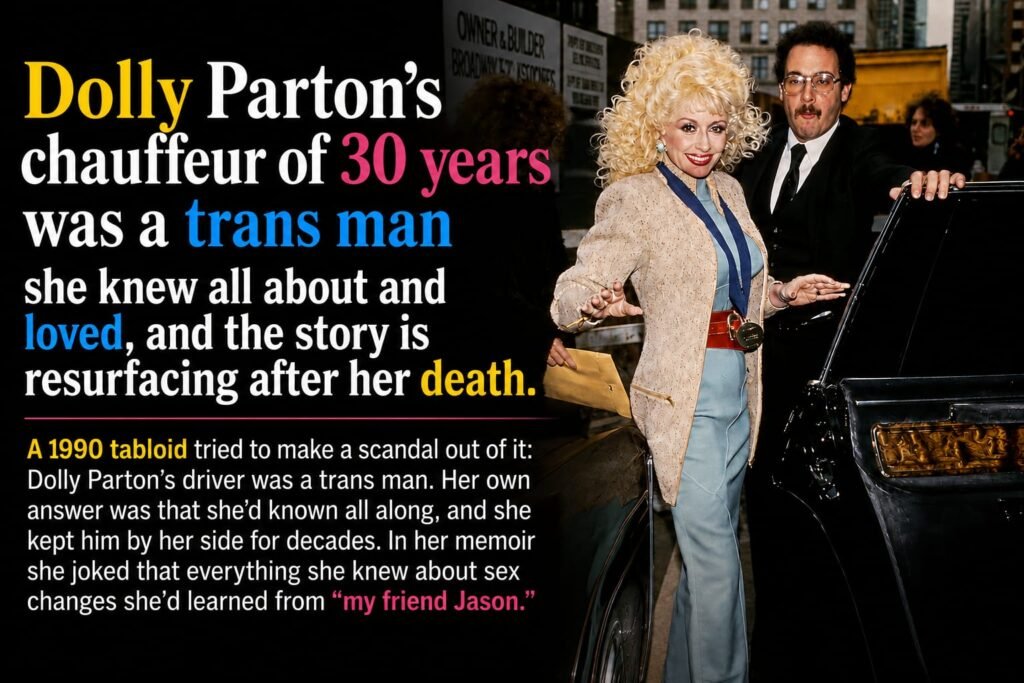
Dolly Parton's influence extends beyond music through her work in entertainment, literacy and philanthropy.
Dolly Parton has spent decades building a legacy that reaches far beyond country music. Known around the world for her unmistakable voice, songwriting talent and larger-than-life stage presence, Parton also became a successful businesswoman and one of entertainment’s most recognizable philanthropists.
A recent tribute published by Michele Goodwin looks back at the many dimensions of Parton’s public life, focusing on her music, advocacy, charitable work and cultural influence. The source also contains a claim regarding Parton’s death that should be independently verified through current and authoritative sources before being presented as confirmed news.
What is not in dispute is the extraordinary scope of the career and philanthropic work described in the tribute. From songs about heartbreak and working life to millions of books delivered to young children, Parton’s influence has reached audiences far beyond the concert stage.
Dolly Parton Turned Personal Experience Into Timeless Songs
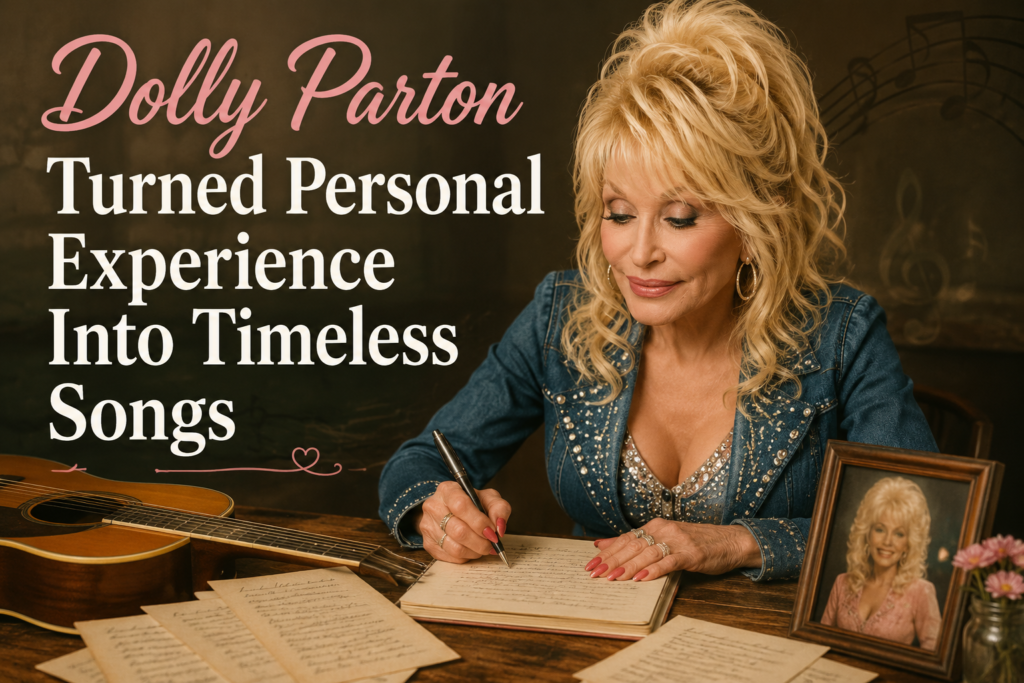
Born in Sevier County, Tennessee, in 1946, Dolly Parton grew up in a large family in the Smoky Mountains. Her early life and Appalachian roots would become an important part of her artistic identity.
Rather than hiding the hardships of her upbringing, Parton frequently drew on themes of poverty, family sacrifice, ambition, love and survival in her music. Many of her songs told deeply personal stories while connecting with listeners who recognized similar struggles in their own lives.
Her recording career began to take shape in the 1960s, and her 1967 debut album, Hello, I’m Dolly, introduced a performer who would eventually become one of the most prolific songwriters in American popular music.
Over the years, Parton wrote thousands of songs. Among her best-known works are “Jolene,” “Coat of Many Colors” and “I Will Always Love You.”
The songs were different in tone and subject matter, but they shared one of Parton’s greatest strengths as a writer: the ability to tell emotionally direct stories in language that felt accessible to a wide audience.
‘I Will Always Love You’ Found a New Generation of Fans
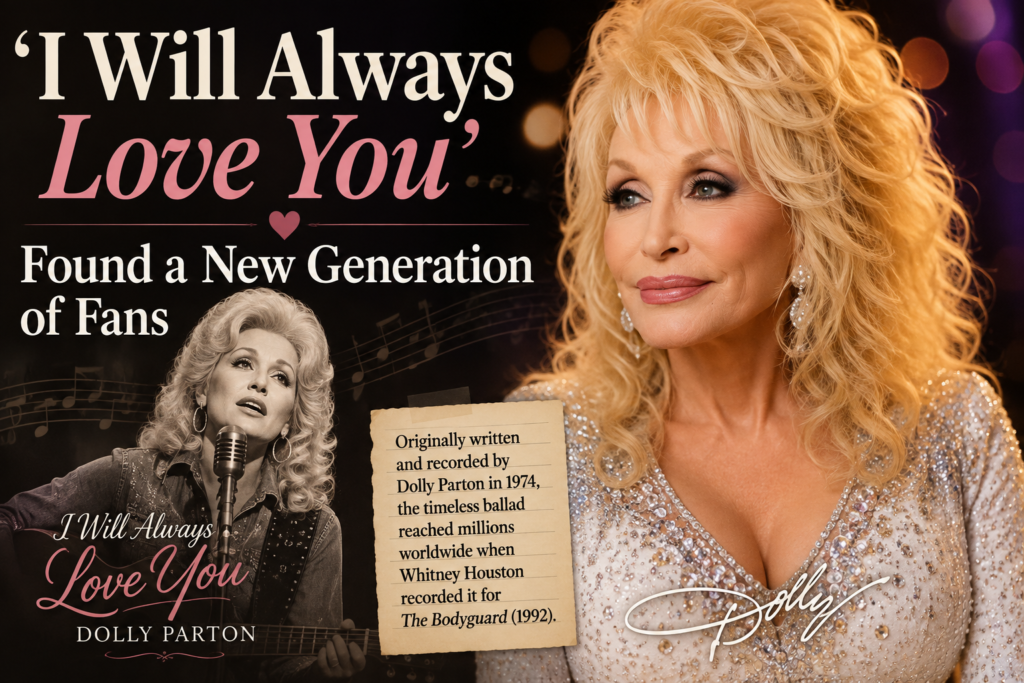
“I Will Always Love You” became one of the most famous examples of Parton’s songwriting power.
Parton first recorded the song in 1974, but it later reached an even larger international audience when Whitney Houston recorded her own version for the 1992 film The Bodyguard.
Houston’s rendition became a worldwide phenomenon and introduced many listeners to a song that Parton had written years earlier.
The success of Houston’s version also demonstrated the remarkable reach of Parton’s songwriting. Her work could move between musical styles and generations while continuing to connect with new audiences.
The supplied tribute notes that Parton later spoke about using royalties associated with Houston’s recording to invest in a predominantly Black neighborhood in Nashville. That specific account should be checked against primary or authoritative reporting before publication.
Still, the continued success of “I Will Always Love You” remains an important example of how Parton’s songwriting has lived beyond any single recording or performer.
How ‘9 to 5’ Became an Anthem for Working Women
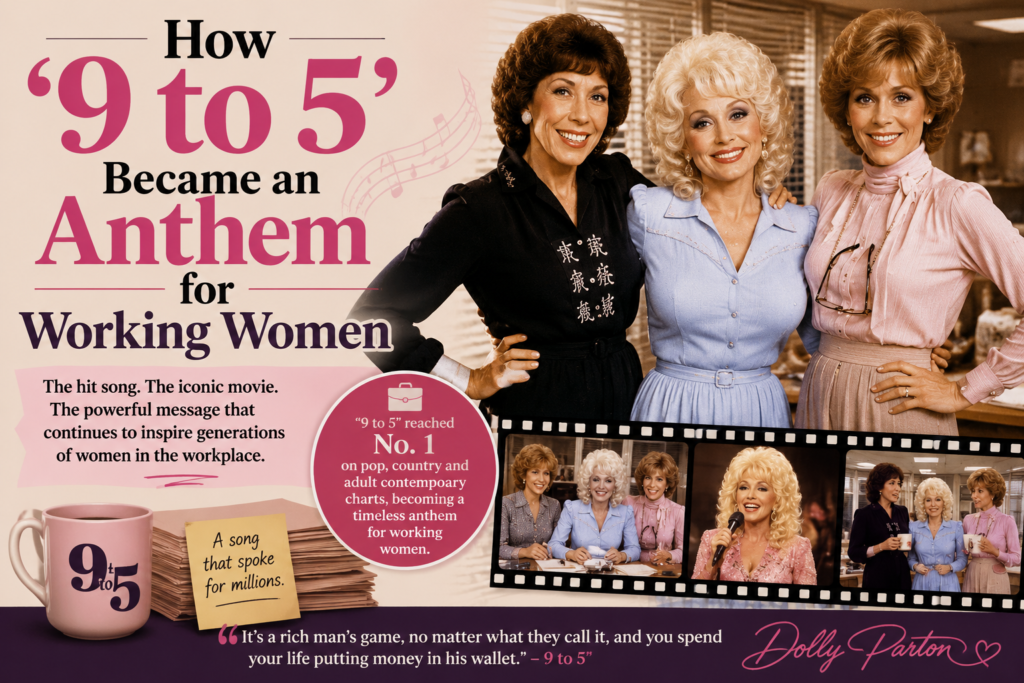
Parton’s influence was not limited to country music.
In 1980, she starred in the comedy 9 to 5 alongside Jane Fonda and Lily Tomlin. The film focused on three women dealing with an arrogant and sexist boss while navigating the frustrations of the workplace.
The story resonated because it addressed issues that many women recognized, including workplace discrimination, harassment, lack of respect and unequal opportunities.
Parton also performed the film’s title song, “9 to 5,” which became one of the defining hits of her career.
The song reached the top of multiple charts and became closely associated with the experiences of working women. Its catchy rhythm and sharp lyrics helped turn a story about workplace frustration into a major cultural moment.
Decades later, the themes connected to 9 to 5 continue to be discussed in conversations about gender, pay and professional equality.
Parton’s performance showed another side of her talent. She could address serious experiences while maintaining the humor and warmth that helped make her appealing to mainstream audiences.
Dolly Parton’s Imagination Library Changed Her Philanthropic Legacy
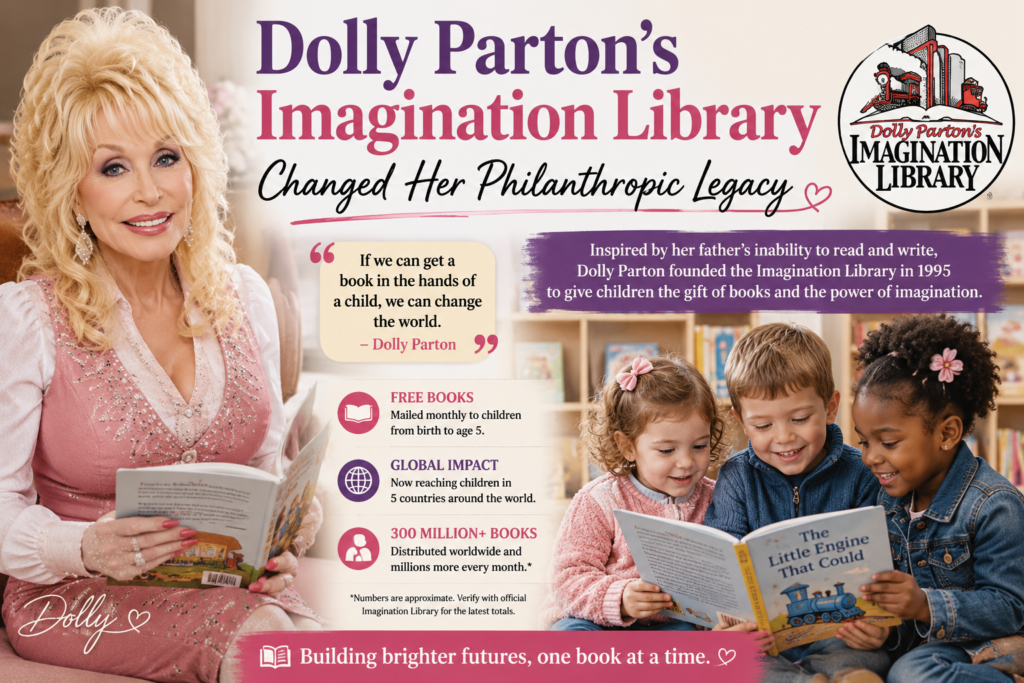
For many families, Dolly Parton’s name is associated not only with music but also with books.
In 1995, she founded Dolly Parton’s Imagination Library, a literacy initiative inspired by her father’s inability to read and write.
The program began in her home region before expanding into a much larger international effort. It provides free, age-appropriate books to children from birth through age five, without basing eligibility on a family’s income.
The initiative became one of the most recognizable celebrity-backed literacy programs in the world.
According to the supplied source, the program has distributed more than 300 million books and continues to send millions of books to children. Because those totals change over time, the latest figures should be verified with the official organization before publication.
The broader mission, however, has remained clear: helping young children develop an early relationship with reading.
Parton’s connection to literacy was deeply personal. The tribute describes her understanding of reading and writing as tools that can expand opportunity and imagination.
For a performer whose own career was built on storytelling, the effort to place books in the hands of children became one of the most lasting parts of her public work.
Her Charitable Work Also Reached Healthcare and Disaster Victims
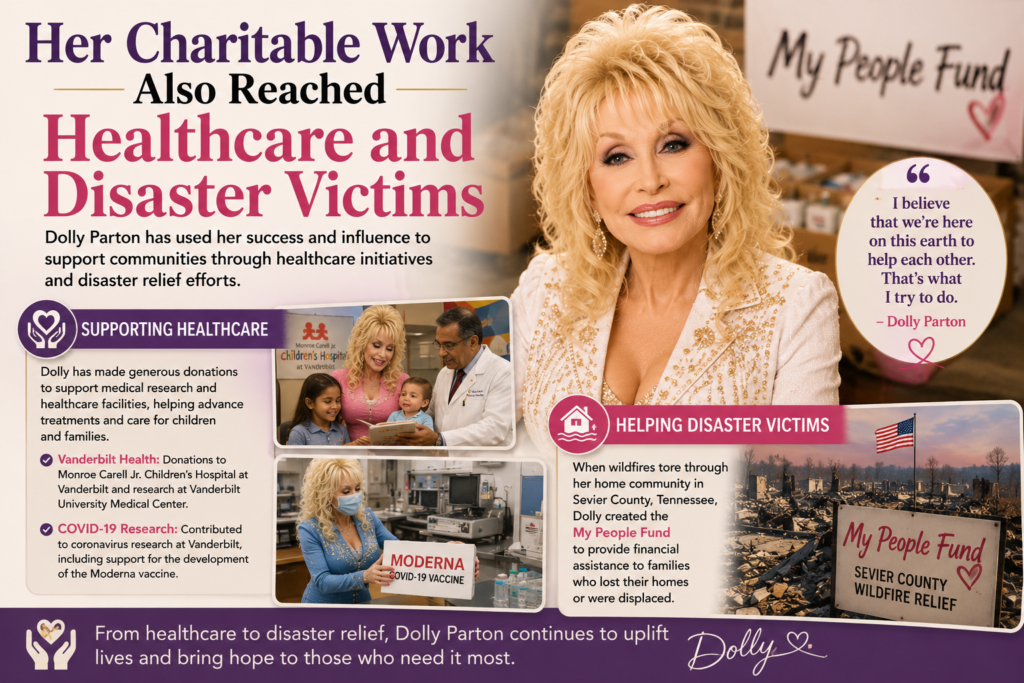
Parton’s philanthropy extended beyond education.
The source highlights her support for healthcare and medical research, including donations connected to the Monroe Carell Jr. Children’s Hospital at Vanderbilt and coronavirus research at Vanderbilt University Medical Center.
During the COVID-19 pandemic, Parton’s contribution to research connected with the development of the Moderna vaccine received widespread attention. Specific details about the amount and use of funding should be verified against official institutional records when publishing an updated article.
She also responded to crises affecting her home community.
After devastating wildfires struck Sevier County in 2016, Parton created the My People Fund to provide financial assistance to families whose homes had been destroyed or made uninhabitable.
The response reflected a pattern seen throughout her philanthropic work: using the financial success created by her entertainment career to support people facing difficult circumstances.
Parton Spoke About Inclusion and Human Dignity
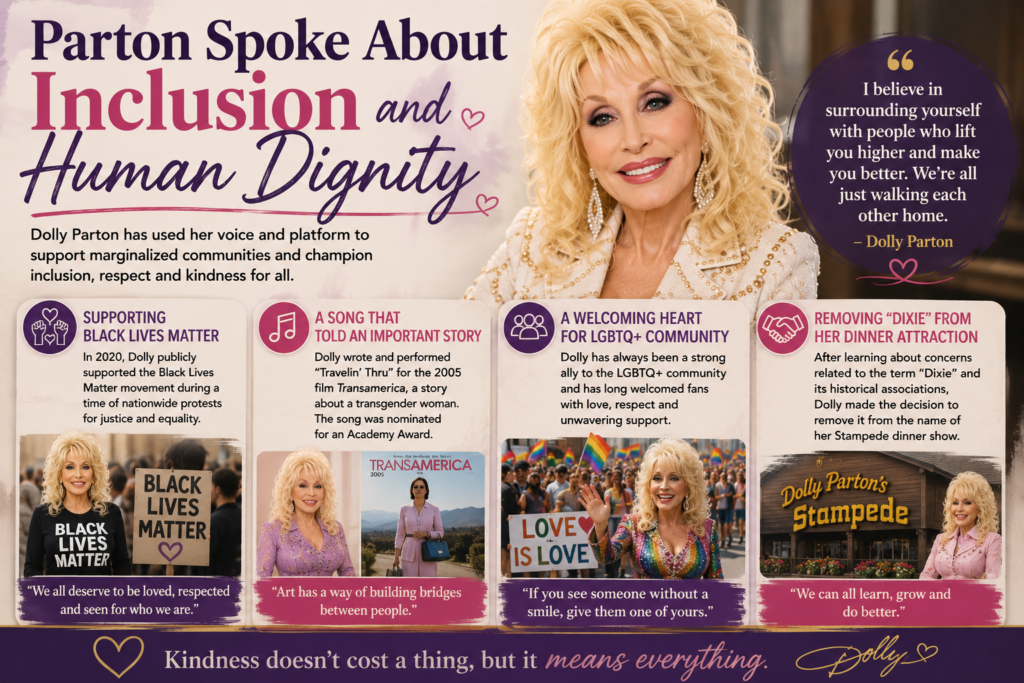
The supplied tribute also examines moments when Parton publicly addressed issues involving marginalized communities.
In 2020, she made comments supporting the statement that Black lives matter during a period of nationwide protests following several high-profile killings.
The article also references her decision to remove “Dixie” from the name of her Stampede dinner attraction after concerns about the term and its historical associations.
Parton also maintained a longstanding connection with LGBTQ+ fans and publicly expressed support for LGBTQ+ people.
Her work included writing “Travelin’ Thru” for the 2005 film Transamerica, a story centered on a transgender woman. The song received an Academy Award nomination.
Although Parton often avoided defining herself through a specific political identity, the source presents these moments as part of a broader public approach centered on treating people with dignity.
A Career Built on More Than Celebrity
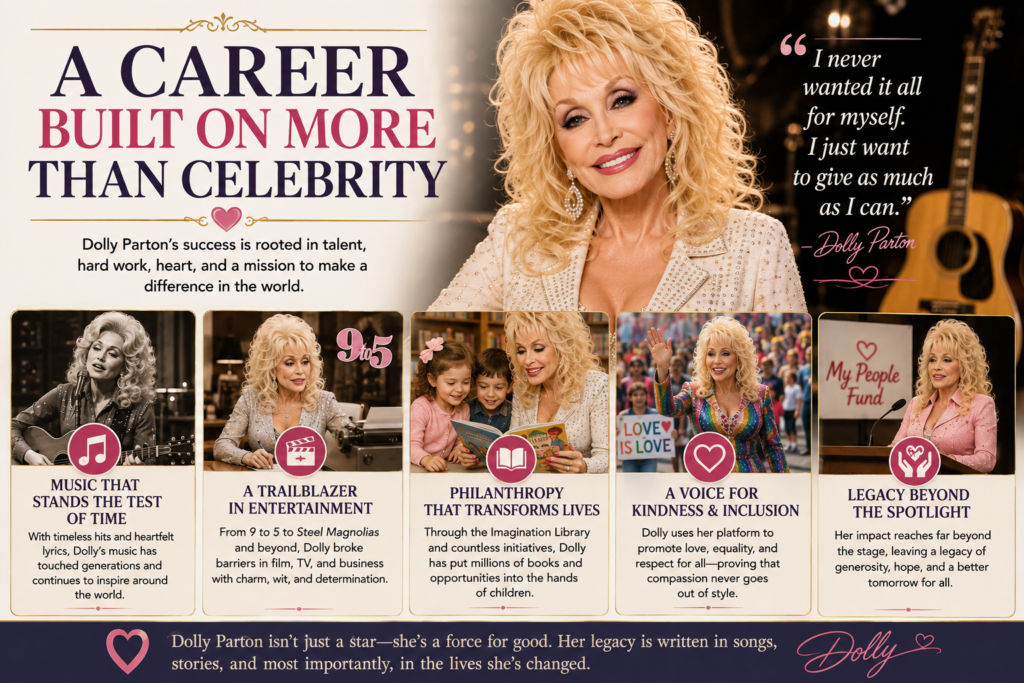
Dolly Parton’s career has always contained contradictions that somehow worked together.
She embraced glamour while speaking openly about humble beginnings. She became a global celebrity while maintaining strong connections to East Tennessee. She built a major entertainment empire while also investing heavily in education, healthcare and disaster relief.
That combination helped make her one of the most distinctive figures in American entertainment.
For some fans, her legacy begins with songs such as “Jolene.” For others, it is 9 to 5, The Bodyguard-era success of her songwriting, Dollywood or the books that arrive through the Imagination Library.
The different parts of her career are connected by the same ability to communicate with people across generations and backgrounds.
Her story is not simply one of commercial success. It is also the story of how a performer used the influence created by entertainment to support causes outside the spotlight.
Why Dolly Parton’s Legacy Continues to Matter
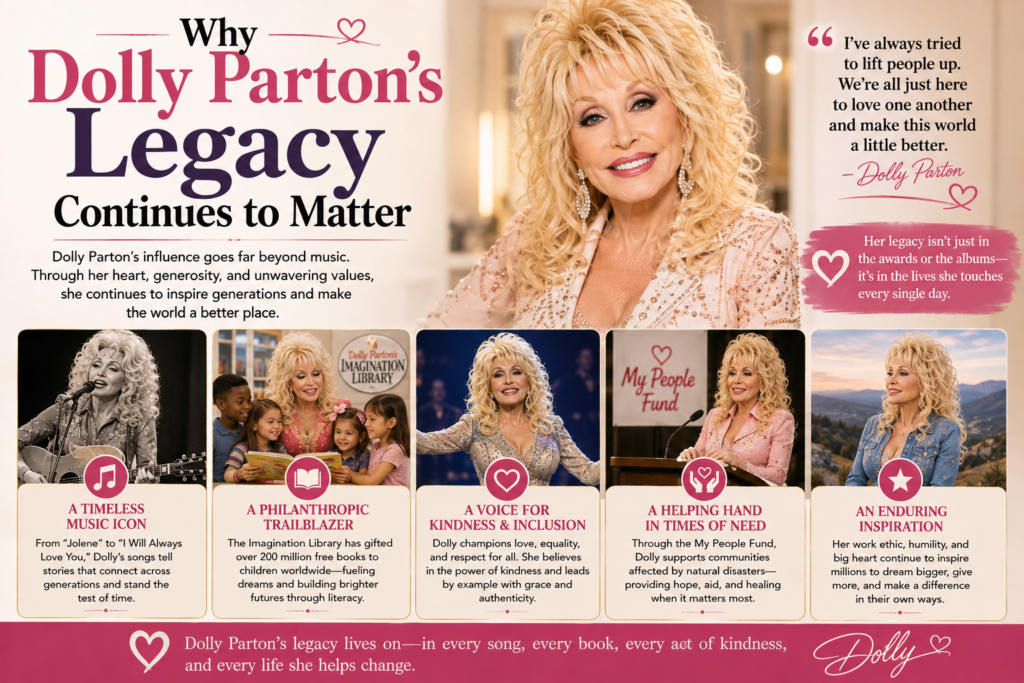
The strongest part of Parton’s public legacy may be its range.
Her songs gave listeners stories about love, heartbreak, family and survival. Her work in 9 to 5 helped create a cultural touchstone about the experiences of women in the workplace. Her Imagination Library brought books to children, while her charitable donations supported communities facing illness and disaster.
Few entertainers have built such a broad connection between artistic success and philanthropy.
The tribute supplied as the source describes Parton as a figure whose influence was measured not only by records sold or awards received, but also by the people and communities reached through her charitable work.
However, the source’s reported claim concerning her death requires immediate independent verification before it can be treated as established fact in a news publication.
Any final breaking-news version of this story should confirm that claim through authoritative and current sources, including official representatives or other reliable reporting.
Until then, the safer and more accurate focus remains the documented body of work that made Dolly Parton one of the most influential names in entertainment and philanthropy.
Her songs remain part of popular culture. Her stories continue to find new audiences. And her efforts to support children, families and communities have created a legacy that extends far beyond the music that first made her famous.