

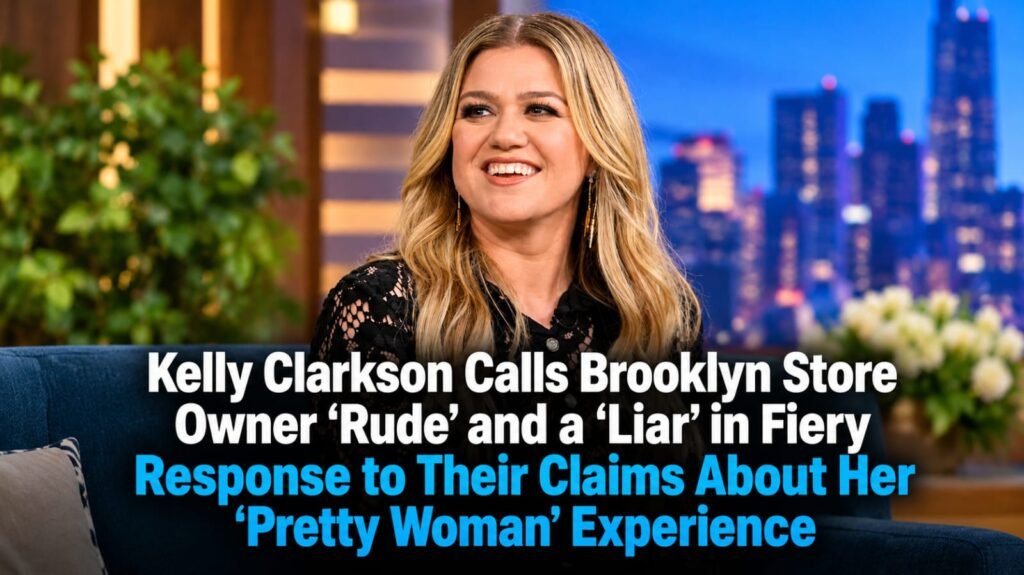
Kelly Clarkson responds to a Brooklyn store's claims about her Pretty Woman shopping experience.
Kelly Clarkson is speaking out after a disagreement with a Brooklyn store over an alleged shopping experience that she says left her feeling judged and disrespected. The singer and television personality recently criticized the New York City business on social media, comparing the encounter to a memorable scene from the 1990 romantic comedy Pretty Woman.
The controversy intensified after the store, Art of Play, publicly disputed her account, explaining that the item she reportedly wanted to purchase was not for sale. Clarkson subsequently pushed back against the business’s explanation, calling its response dishonest and accusing the staff member involved of treating her condescendingly.
The disagreement has attracted attention online, raising questions about customer service, assumptions about shoppers, and how quickly a dispute between a celebrity and a small business can become a public controversy.
Kelly Clarkson Describes an Unpleasant Shopping Experience
The dispute began on Saturday, October 10, when Clarkson shared her frustration about visiting Art of Play, a Brooklyn shop known for its distinctive collection of toys, games, puzzles, books, and unusual decorative objects.
According to Clarkson, she had traveled to the store because she was interested in exploring its merchandise and potentially making several purchases. However, she claimed that her interaction with a staff member did not meet her expectations.
In a post on X, the singer said she felt as though she was being viewed as someone who could not afford the merchandise. She also alleged that the employee offered to find something comparable for her, which she interpreted as an assumption that she would not purchase the item she was interested in.
Clarkson expressed her frustration directly, suggesting that the business had lost a significant potential sale because of the interaction.
Her comments quickly attracted attention from fans and entertainment followers, many of whom were interested in learning what had happened during the visit.
The singer’s criticism was not simply about whether she could purchase a particular object. Her complaint focused on how she believed she had been treated while attempting to shop.
For many customers, the experience of entering a store involves more than examining products and comparing prices. Feeling welcome, respected, and taken seriously can also influence whether someone decides to make a purchase.
Clarkson’s account brought that issue into the spotlight.
Why Kelly Clarkson Compared the Incident to Pretty Woman
One detail that made the controversy especially memorable was Clarkson’s reference to Pretty Woman, the 1990 romantic comedy starring Julia Roberts and Richard Gere.
In the film, Roberts plays Vivian Ward, a woman who encounters dismissive treatment from sales staff while shopping at an upscale boutique. The employees make assumptions about her based on her appearance rather than giving her the same attention they might offer another customer.
After shopping elsewhere, Vivian returns to the original store and confronts the saleswoman, pointing out that the boutique missed an opportunity by refusing to treat her respectfully.
The scene has become one of the film’s most recognizable moments, often associated with unfair judgments, snobbery, and the consequences of underestimating customers.
Clarkson used that cultural reference to describe how she felt during her visit to Art of Play. Her comparison suggested that she believed the employee had made assumptions about her financial ability or willingness to spend money.
The reference also helped explain why the incident resonated with audiences. Many people have experienced situations in which they felt ignored, judged, or treated differently while shopping.
However, the comparison reflects Clarkson’s interpretation of the encounter. The full interaction has not been independently established, and the store subsequently offered a different explanation for the disagreement.
Art of Play Responds to Kelly Clarkson’s Allegations
Following Clarkson’s public criticism, Art of Play addressed the situation in a statement shared on Instagram on Sunday, October 11.
The store explained that Clarkson had visited the business and asked about purchasing a distinctive singing and dancing bird automaton known as Molly.
According to the business, the unusual mechanical bird plays an important role in the magic shows hosted at the store. Art of Play stated that the object is permanently attached to the wall and is not available for purchase.
The explanation directly challenged the circumstances described by Clarkson, who later maintained that the employee had discussed a price with her and offered to find a comparable alternative.
Art of Play also acknowledged the broader issue raised by the singer’s account. The business recognized that the negative experience she described would resonate with people who have felt judged while visiting a shop.
The store emphasized that it welcomes customers whether they intend to buy something or simply want to explore its merchandise and activities.
It also expressed surprise at the scale of the online reaction, saying that a small local business had suddenly found itself at the center of widespread criticism from people who had never visited.
The response highlighted the difficult position a small business can face when a disagreement becomes a major social media story.
At the same time, the store’s explanation did not settle the dispute. Instead, it created a direct disagreement between two different accounts of what happened during the shopping visit.
Kelly Clarkson Calls the Store Owner Rude and a Liar
Clarkson was not satisfied with the store’s explanation and responded publicly on Sunday.
In her follow-up comments, she disputed the claim that the singing bird had never been available for purchase.
Clarkson said she had specifically asked about the item while pointing to a price tag displaying the words “Singing Bird.” According to her account, the employee told her that it cost $15,000 and offered to find something comparable.
She argued that this conversation contradicted the store’s subsequent statement that the object was permanently attached to the wall and not for sale.
In response, Clarkson accused the business of being both rude and dishonest.
She also shared an image that appeared to show the item and a price tag, presenting it as support for her version of events. The image formed part of her public challenge to the store’s explanation.
Clarkson further rejected any suggestion that her criticism was unfair simply because the business was independently owned.
She explained that she supports small businesses and pointed out that she had visited the shop because she was interested in purchasing merchandise.
Her central argument was that independent businesses deserve support, but their size or local status should not excuse disrespectful treatment of customers.
Clarkson also acknowledged that she found the store itself interesting, separating her criticism of the interaction from her opinion of the shop’s merchandise and atmosphere.
Her response made clear that she believed the disagreement concerned the employee’s behavior as well as the conflicting explanations about the bird automaton.
At the time of the latest reports, the two sides had presented different versions of the encounter, and the central disagreement remained unresolved.
What Is Art of Play, the Brooklyn Store at the Center of the Controversy?
Art of Play is a Brooklyn-based retail business offering a distinctive assortment of products, including games, puzzles, toys, books, and unusual objects designed to encourage curiosity and interaction.
Unlike a conventional store focused on a single product category, the business presents itself as a destination for people interested in discovering unusual items and exploring playful experiences.
Its connection to magic and interactive entertainment is particularly relevant to the current controversy because the store says Molly, the singing and dancing bird, is used in its magic shows.
According to the business, the automaton’s role in those performances is the reason it remains attached to the wall and is not available for purchase.
That explanation introduces an important distinction: an object displayed in a retail environment may not necessarily be merchandise available for sale.
Nevertheless, Clarkson’s account raises a separate question about communication. If a customer asks about an item and believes a price has been quoted, the way the employee explains its availability can significantly affect the interaction.
Clear explanations can prevent misunderstandings, while a response perceived as dismissive can leave customers feeling unwelcome.
The disagreement does not establish that every customer has had a similar experience at Art of Play. Nor does the store’s explanation independently establish precisely how the conversation with Clarkson unfolded.
Both points are important when evaluating the controversy fairly.
Social Media Reactions Put Customer Service in the Spotlight
The disagreement quickly became a talking point among entertainment followers and social media users.
Some people expressed support for Clarkson, arguing that customers should not feel judged based on their appearance or perceived financial status. From this perspective, the incident illustrates why respectful communication matters regardless of who enters a store.
Others emphasized the potential consequences for a small business when a celebrity shares a negative experience with a large audience.
A public complaint from a well-known entertainer can reach millions of people in a short period. Even customers who have never visited the business may form an opinion based on a handful of posts and statements.
That attention can create pressure for a business to respond quickly, explain its policies, and defend its reputation.
The controversy also demonstrates how social media can turn a relatively ordinary customer-service disagreement into a wider debate about fairness, accountability, and public influence.
However, online reactions should not automatically be treated as proof that either side’s account is correct. Supportive comments, criticism, and viral posts can reflect personal opinions rather than independently verified facts.
The most reliable way to understand the dispute is to distinguish between what Clarkson says happened, what Art of Play says happened, and what remains unconfirmed.
Why the Controversy Has Resonated With So Many People
At its heart, the disagreement touches on a familiar experience: wanting to be treated respectfully when entering a business.
Customers generally expect staff to answer questions, explain prices, and clarify whether products are available. They may also expect a reasonable level of courtesy, regardless of whether they ultimately make a purchase.
When someone feels that an employee has made assumptions about their budget, appearance, or intentions, the interaction can become uncomfortable.
Clarkson’s celebrity status has brought additional attention to the issue, but the underlying question applies to everyday shoppers as well.
Retail employees also face challenges. They may need to explain that an item is a display piece, unavailable, reserved, or too fragile to sell. Those explanations can sometimes be misunderstood, particularly when expectations differ.
The important distinction is between communicating a genuine limitation and making a customer feel personally judged.
In this case, the precise conversation remains disputed. Clarkson says the interaction was condescending and that the bird’s displayed price contradicted the store’s later explanation. Art of Play says the bird was a permanent fixture that was never for sale.
Without independently verified evidence establishing the full exchange, it would be premature to treat either account as conclusively proven.
What Happens Next in the Kelly Clarkson and Art of Play Dispute?
For now, the disagreement remains a public dispute over a shopping interaction and the availability of an unusual mechanical bird.
Clarkson has defended her account and challenged the store’s explanation. Art of Play has described the bird as a permanent part of its magic-show setup and has emphasized its intention to welcome customers.
Whether the two sides eventually clarify the disagreement privately or issue further public statements remains to be seen.
The incident also offers a broader reminder about the power of online communication. A single post can bring attention to a customer-service complaint, but it can also expose a small business to intense scrutiny before every detail is clear.
For customers, the situation highlights the importance of respectful treatment and transparent communication. For businesses, it illustrates why explaining product availability clearly and responding calmly to criticism can matter when misunderstandings arise.
Ultimately, the controversy is not just about a $15,000 singing bird. It is about two conflicting accounts of an interaction, the expectations customers bring into retail spaces, and the speed with which social media can amplify a disagreement.
As the story develops, the distinction between allegations and established facts will remain essential.
For now, Kelly Clarkson has made her position clear: she believes she was treated disrespectfully and does not accept the store’s explanation. Art of Play, meanwhile, maintains that the item she asked about was not for sale.
The disagreement has put both customer service and small-business reputation in the spotlight, leaving audiences to consider the competing accounts while awaiting any further clarification.