
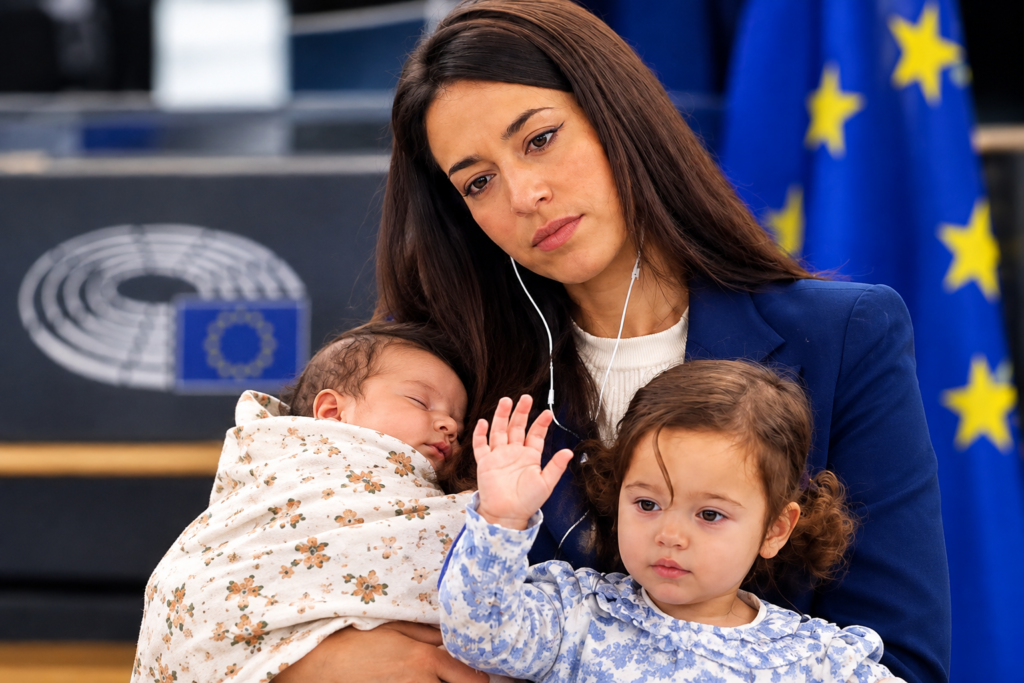
Italian politician Licia Ronzulli brought her young daughter to Parliament, sparking discussion about working motherhood.
Italian politician Licia Ronzulli became the subject of international attention after bringing her infant daughter, Vittoria, with her to the European Parliament. What initially appeared to be a single striking photograph soon became part of a much larger story about motherhood, professional responsibilities and the challenges women can face while building demanding careers.
In September 2010, Ronzulli arrived at a plenary session of the European Parliament in Strasbourg carrying her newborn daughter. Vittoria was only around seven weeks old at the time. Ronzulli took part in parliamentary business while holding the baby, creating an image that quickly spread through international media.
The photograph stood out because political institutions are often associated with formal meetings, debates and voting rather than the everyday realities of family life. Ronzulli’s decision placed those two worlds directly alongside each other.
But the story did not end with that first photograph. Her daughter appeared with her mother at the European Parliament on other occasions, and Ronzulli later explained that she had spent years balancing her political responsibilities with caring for her child.
The Photograph That Put Ronzulli in the Spotlight
The moment that made Ronzulli internationally recognizable happened in September 2010.
At the time, she was serving as a Member of the European Parliament. She attended a plenary session in Strasbourg with her young daughter, who was just weeks old. While other lawmakers carried out their parliamentary duties, Ronzulli participated in a vote with her baby in her arms.
The image immediately attracted attention because it was unusual to see a newborn inside such a formal political environment.
However, the circumstances behind the photograph were important. Ronzulli’s decision was connected to the practical realities of being a new mother. Contemporary reporting linked her appearance with wider discussions about women’s employment and the difficulties of combining a career with raising children.
Rather than treating motherhood and political work as completely separate parts of her life, Ronzulli visibly brought both responsibilities into the same workplace.
That helped transform an ordinary family decision into a much broader public discussion.
Why She Brought Her Baby to Parliament
Ronzulli later explained that she had brought Vittoria with her because she was breastfeeding and did not want to leave her newborn daughter behind.
The decision also reflected the difficulties that can arise when a parent has an important professional commitment while caring for a very young child.
For many working parents, balancing a newborn’s needs with employment can involve difficult choices. In Ronzulli’s case, her workplace happened to be one of Europe’s most visible political institutions, meaning her personal decision was photographed and discussed around the world.
The situation also gave her an opportunity to highlight issues affecting women in the workplace.
Her appearance became particularly notable because it happened during a period when European policymakers were debating employment conditions, equality and the ability of women to remain professionally active while raising children.
The photograph therefore carried a message beyond the image itself.
Her Daughter Was Seen With Her Again
Although the 2010 photograph became the most famous image associated with Ronzulli, it was not an isolated event.
Vittoria was photographed accompanying her mother at the European Parliament on later occasions. In February 2012, reports again showed Ronzulli attending a parliamentary session with her daughter.
By then, Vittoria was no longer a newborn. The later images showed how much she had grown since the first photograph and reinforced the idea that Ronzulli’s experience involved more than a single day in parliament.
Photographs from the following years also documented the pair together in Strasbourg.
The continuing appearances helped turn Ronzulli’s story into a longer example of a politician navigating professional responsibilities while raising a child.
Ronzulli Later Described Three Years of Working With Her Daughter
One of the reasons the story is sometimes described online as a politician bringing her baby to parliament for three years comes from Ronzulli’s own later comments.
In a 2016 interview, she discussed her experience of raising Vittoria while continuing her professional career. Ronzulli said she had brought her daughter into the parliamentary environment when the child was a newborn and described spending three years working with Vittoria beside her.
That statement provides useful context for the viral version of the story.
It would be misleading, however, to interpret the claim as meaning that Vittoria was physically present at every parliamentary session for three consecutive years. The available reporting instead supports the broader description that Ronzulli repeatedly brought her daughter with her and later described working alongside her for about three years.
That distinction is important when presenting an older viral story accurately.
A Debate About Motherhood and Career
The images of Ronzulli and her daughter attracted attention partly because they challenged traditional expectations about professional women.
For decades, women have faced questions about how motherhood might affect their careers. In highly demanding professions, new parents can encounter practical difficulties involving childcare, schedules, travel and workplace expectations.
Political careers can make those challenges even more complicated because elected officials may have long working hours, public appearances, travel obligations and unpredictable schedules.
Ronzulli’s decision did not eliminate those challenges, but it made them visible.
Her appearance also encouraged people to consider whether workplaces should provide greater flexibility for parents rather than expecting employees to keep family responsibilities completely out of sight.
That discussion remains relevant well beyond politics.
The Image Became Bigger Than the Individual Moment
One reason the photograph continues to circulate is its simplicity.
There is no complicated political speech in the image. Instead, it shows a mother participating in her professional responsibilities while caring for her baby.
That visual contrast made the photograph memorable.
The European Parliament is associated with formal political activity, while a newborn represents one of the most personal aspects of family life. Seeing the two together created a powerful image that could be understood even by people unfamiliar with Ronzulli’s political career.
As the photograph traveled through newspapers and social media, it became a recognizable example in discussions about working mothers.
Some people viewed the image as an empowering statement about women’s ability to remain active professionally after becoming mothers. Others saw it as evidence that workplaces need to become more accommodating toward parents.
The photograph could therefore be interpreted in different ways, but its central message was difficult to miss: motherhood had not removed Ronzulli from her professional role.
Who Is Licia Ronzulli?
Licia Ronzulli was born in Milan, Italy, in 1975.
Before entering politics, she worked in the healthcare field. Her professional background included work connected with medical and humanitarian activities before she moved into European politics.
Ronzulli became a Member of the European Parliament in 2009 and served there until 2014.
Her time in the European Parliament placed her at the center of European political discussions, but her public profile expanded considerably after the photographs with her daughter attracted international attention.
She later entered Italian national politics and became a member of Italy’s Senate.
According to the Italian Senate’s official records, Ronzulli represents Lombardy and has served as a Vice President of the Senate since November 2023.
Her political career therefore continued long after the photographs of her daughter at the European Parliament first became famous.
Vittoria’s Role in the Story
Ronzulli’s daughter Vittoria was born in August 2010, shortly before the famous parliamentary photograph.
That timing is significant because it explains why the image attracted so much attention. Ronzulli was not bringing an older child into the workplace for a casual visit. She was a new mother with a baby only weeks old.
The later photographs of Vittoria at the European Parliament also created a visual timeline of the child’s early years alongside her mother’s political career.
The images showed a side of political life that is rarely visible to the public.
Politicians are normally photographed during speeches, campaigns, meetings and official events. Ronzulli’s photographs showed something different: a mother managing an important professional role while caring for her young child.
That contrast helped make the story memorable.
What the Story Says About Working Parents
The story of Ronzulli and her daughter is ultimately less about one photograph and more about the ongoing question of how parents can combine family and professional responsibilities.
There is no single solution that works for everyone.
Some parents rely on childcare, others adjust their schedules, work remotely when possible or receive support from family members. In Ronzulli’s case, bringing her daughter with her became part of how she managed the demands of her professional life during her child’s early years.
Her experience also demonstrates why workplace flexibility can matter.
A parent may be fully committed to a career while still needing to care for a child. Treating those responsibilities as mutually exclusive can create unnecessary barriers, particularly for women who are returning to demanding careers after having children.
Ronzulli’s decision brought that issue into an unusually visible setting.
Why the Story Still Resonates
The original photograph is now more than a decade old, but it continues to resurface because the underlying issue has not disappeared.
Working parents still face questions about childcare, parental leave, flexible schedules and career progression. Women in particular continue to navigate expectations surrounding both professional achievement and motherhood.
Ronzulli’s experience offers a historical example of one politician’s approach to that challenge.
It is also a reminder that viral posts can simplify complicated stories.
Social-media versions sometimes suggest that Ronzulli simply brought her baby to parliament for three straight years. The documented history is more nuanced. She brought her daughter to the European Parliament on multiple occasions, and she later said that she worked with her daughter beside her for three years.
Keeping that distinction clear makes the story more accurate without taking away from the significance of the images.
A Lasting Image of Motherhood in Politics
Licia Ronzulli’s photographs with her daughter remain memorable because they showed something rarely seen inside a major political institution.
A mother was doing her job while caring for her newborn.
The image did not prove that balancing motherhood and a demanding career is easy. Instead, it highlighted the practical reality that many working parents experience: professional responsibilities do not automatically disappear when a child is born.
For Ronzulli, motherhood became part of her public story rather than something completely separated from her political career.
Her daughter Vittoria’s appearances alongside her mother also turned what could have been a single viral moment into a longer chapter in Ronzulli’s life.
More than a decade later, the photographs continue to prompt conversations about women, careers and family life.
Ultimately, the story is not simply about a politician carrying a baby into parliament. It is about the visibility of working motherhood and the idea that professional ambition and family responsibilities can exist at the same time.
Ronzulli’s experience remains a striking example of how one personal decision can become part of a much larger conversation about the changing expectations placed on working parents.