
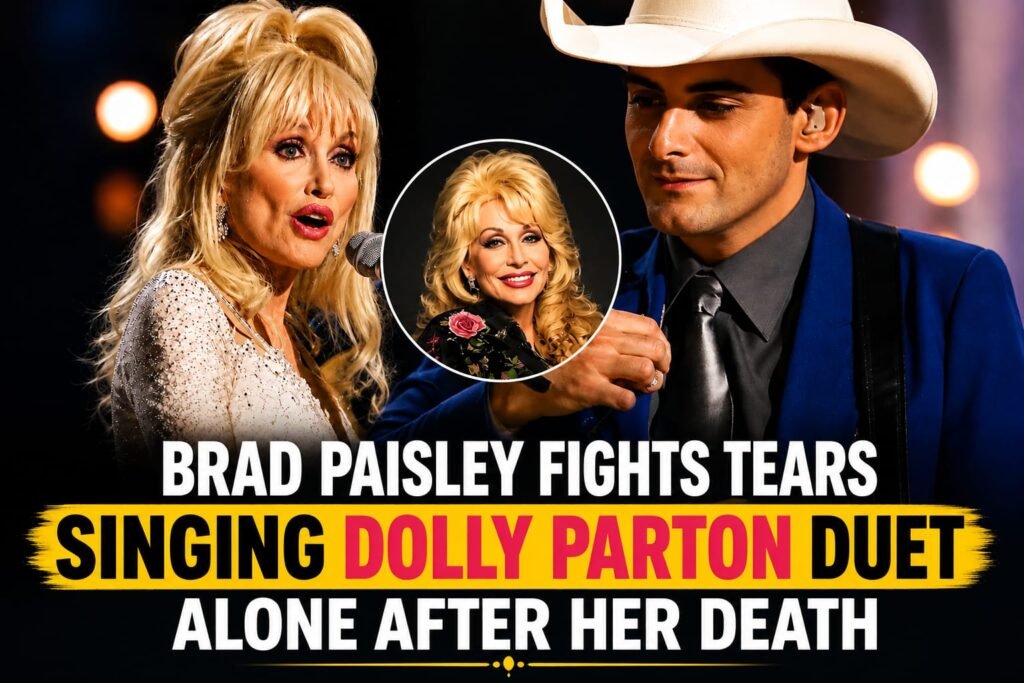
Brad Paisley becomes emotional while performing “When I Get Where I’m Going” alone in tribute to Dolly Parton.
Brad Paisley found himself facing an unexpectedly emotional moment onstage when he performed one of his best-known collaborations with Dolly Parton without her by his side.
Just two days after Parton died at age 80, Paisley performed “When I Get Where I’m Going” during his Aug. 27 concert in Bridgeport, Connecticut. The country singer delivered the song acoustically, but the performance carried a weight it never had before. Parton, whose voice had been an essential part of the original recording, was suddenly absent.
As Paisley sang, the emotion became difficult to hide. The song’s message about life, loss and reaching a peaceful destination took on a deeply personal meaning following Parton’s death.
For the audience, it was more than a familiar country song. It became a tribute to a legendary artist, friend and collaborator whose voice had helped make the recording unforgettable.
Brad Paisley Returns to a Song He Shared With Dolly Parton
“When I Get Where I’m Going” first became part of Paisley and Parton’s musical story in 2005.
Paisley recorded the country ballad and invited Parton to contribute vocals. Her distinctive voice added another emotional layer to a song already centered on reflection and what might await beyond this life.
The collaboration quickly became one of the memorable recordings in Paisley’s career.
The song eventually reached No. 1 on Billboard’s Hot Country Songs chart. It marked Paisley’s fifth No. 1 on the chart and became Parton’s 25th and final chart-topper there.
More than 20 years later, Paisley returned to that same song under circumstances neither performer could have imagined when they first recorded it.
Instead of hearing Parton’s voice alongside his, Paisley had to sing her part of the story alone.
That difference was especially noticeable because the song had always been associated with the two artists together.
The Performance Came Just Days After Parton’s Death
Parton died on Aug. 25 at the age of 80 following a brief battle with cancer.
News of her death sent shockwaves through country music and the wider entertainment world. Parton had remained one of the most recognizable figures in American music for decades, making the loss deeply significant for fans and fellow performers.
Paisley’s concert took place only two days later.
That timing made his decision to perform “When I Get Where I’m Going” particularly powerful.
Performers often pay tribute to late musicians by singing their songs, but Paisley had a much more direct connection to this particular piece of music. He wasn’t simply covering one of Parton’s songs. He was performing a song they had recorded together.
The emotional circumstances were impossible to separate from the lyrics.
As Paisley sang the acoustic version, he appeared to struggle with his emotions. The normally polished concert setting became a much more intimate moment between the singer and his audience.
Paisley Remembered How Their Collaboration Began
During the performance, Paisley spoke about the history behind the recording.
He remembered sending the song to Parton and explaining that it had been influenced by losses he had experienced in his own life. At the time, he wasn’t sure whether the subject matter would resonate with her.
Parton, however, immediately connected with the song.
She agreed to sing on it, helping turn Paisley’s recording into a collaboration that would eventually become a major country hit.
Looking back from the stage in 2026, Paisley said something he could never have predicted when the song was first recorded.
“I never thought it would be about her, but it is,” he told the audience.
The words captured the strange reality of performing the song after Parton’s death.
A song originally written and recorded as a reflection on loss had now become part of Paisley’s own grieving process.
The Lyrics Took on a Different Meaning
Music can change meaning depending on when and where it is heard.
For years, “When I Get Where I’m Going” had been recognized as a reflective country ballad. Its themes of faith, loss and looking toward a place beyond earthly life resonated with listeners for many different reasons.
But Paisley’s performance after Parton’s death gave the song a new context.
The absence of Parton’s voice was itself part of the performance.
Fans who knew the original recording would have immediately recognized the difference. Her vocals had been one of the defining features of the duet, and without her, Paisley was effectively singing through a memory.
That made the performance feel less like a standard concert number and more like a farewell.
Paisley did not need to dramatically change the song to make the moment meaningful. The circumstances surrounding it had already done that.
A Friendship That Went Beyond the Recording Studio
Paisley’s connection with Parton was not limited to a single hit.
The two artists belonged to different generations of country music, but their careers intersected through music, television appearances, awards events and the broader country community.
Parton’s influence on younger performers has been enormous, and Paisley has long been among the artists who have expressed admiration for her.
After her death, Paisley reflected on what it meant to know her personally.
He described meeting Parton as life-changing and acknowledged that her impact reached far beyond his own experience.
That perspective is important because Parton’s legacy has never been limited to her record sales or awards.
She became a cultural figure whose songs, personality and career reached audiences far outside traditional country music.
For someone like Paisley, who had the opportunity to work directly with her, her absence was therefore deeply personal.
Paisley Said He Never Thought the Moment Would Come
One of the most striking elements of Paisley’s tribute was the sense that Parton had always seemed larger than life.
For generations of fans, she was a constant presence.
She had been making music and appearing in popular culture for so long that the idea of a world without her seemed difficult to imagine.
Paisley expressed a similar feeling when reflecting on her passing.
“I never imagined this day would come,” he said in a message following her death.
That sentiment also came through during the concert.
When musicians lose longtime friends and collaborators, performing their shared material can become both comforting and painful. A familiar song can bring back memories of recording sessions, conversations and performances.
For Paisley, “When I Get Where I’m Going” contained all of that history.
Every line was connected to a recording he made with Parton more than two decades earlier.
Now, he was singing it without her.
Country Music Continues to Remember Dolly Parton
Paisley is far from the only musician to honor Parton following her death.
Artists across the music world have been remembering her through performances, personal messages and stories about the influence she had on their careers.
The tributes reflect the unusual breadth of Parton’s career.
She was a successful singer and songwriter, but she also became an actress, businesswoman, philanthropist and one of the most recognizable personalities in entertainment.
Her songwriting catalog includes songs that became major hits for both herself and other performers. Her influence can be heard across generations of country artists.
That legacy means her music will continue to be performed even though she is no longer here to perform it herself.
Paisley’s emotional rendition is one example of how those songs can suddenly feel different after the loss of the person who helped create them.
Parton’s Legacy Lives Through the Songs She Left Behind
Parton’s career lasted for generations, and her music became part of the soundtrack of countless lives.
Her songs addressed love, heartbreak, ambition, faith, family, hardship and hope. Some were playful, while others explored difficult subjects with unusual directness.
“When I Get Where I’m Going” belongs to the more reflective side of her musical legacy.
The song’s message made it particularly appropriate for a memorial performance, but Paisley’s connection to it made the moment even more personal.
Rather than choosing a song written solely by Parton, he returned to a piece they had created together.
That choice allowed him to honor both her artistry and their relationship.
It also gave fans an opportunity to remember Parton through one of her many memorable collaborations.
Why the Performance Resonated With Fans
There was something especially human about watching Paisley struggle with a song he had performed many times before.
Professional musicians are accustomed to performing under pressure. They can sing through difficult moments, busy schedules and demanding tours.
Grief, however, does not always follow those rules.
A familiar melody can suddenly bring a person back to a particular time, place or relationship.
For Paisley, the circumstances surrounding this performance were still incredibly fresh. Parton had died only two days earlier.
The emotion seen onstage was therefore not simply part of a planned tribute. It reflected the reality that Paisley was still processing the loss.
That authenticity likely made the performance especially meaningful to the people watching.
There was no need for an elaborate production or lengthy speech. Paisley and the song were enough.
A Duet Became a Farewell
“When I Get Where I’m Going” was originally a duet.
Paisley and Parton’s voices shared the recording, creating a musical conversation that became a No. 1 country hit.
On Aug. 27, Paisley stood onstage and performed it without her.
That simple change transformed the song.
What had once been a collaboration became a remembrance.
What had once been a recording about the possibility of someday reaching a peaceful place became, for Paisley, a song about someone he had actually lost.
The emotion was visible, but so was the affection behind it.
Paisley remembered how Parton had responded when he first sent her the song. He remembered the collaboration that followed and the impact she had on his life.
Most importantly, he gave the audience a chance to remember her through music.
Brad Paisley’s Tribute Gives Fans a Final Emotional Connection
Dolly Parton’s death marks the end of an extraordinary chapter in country music, but her songs are not going anywhere.
They remain in recordings, concert setlists, memories and the voices of artists who were influenced by her.
For Paisley, one of those songs now carries a particularly painful significance.
He first recorded “When I Get Where I’m Going” with Parton in 2005. More than two decades later, he returned to it alone, just days after her death.
The performance showed how quickly a song can change when life changes around it.
Paisley may have sung the words many times before, but this time they carried the weight of losing the person who once sang them beside him.
As he fought through his emotions onstage, the performance became an understated farewell to one of country music’s most enduring figures.
Parton may no longer be standing beside him to sing the duet, but her voice remains permanently attached to the song—and to the memories of everyone who heard them perform it together.