

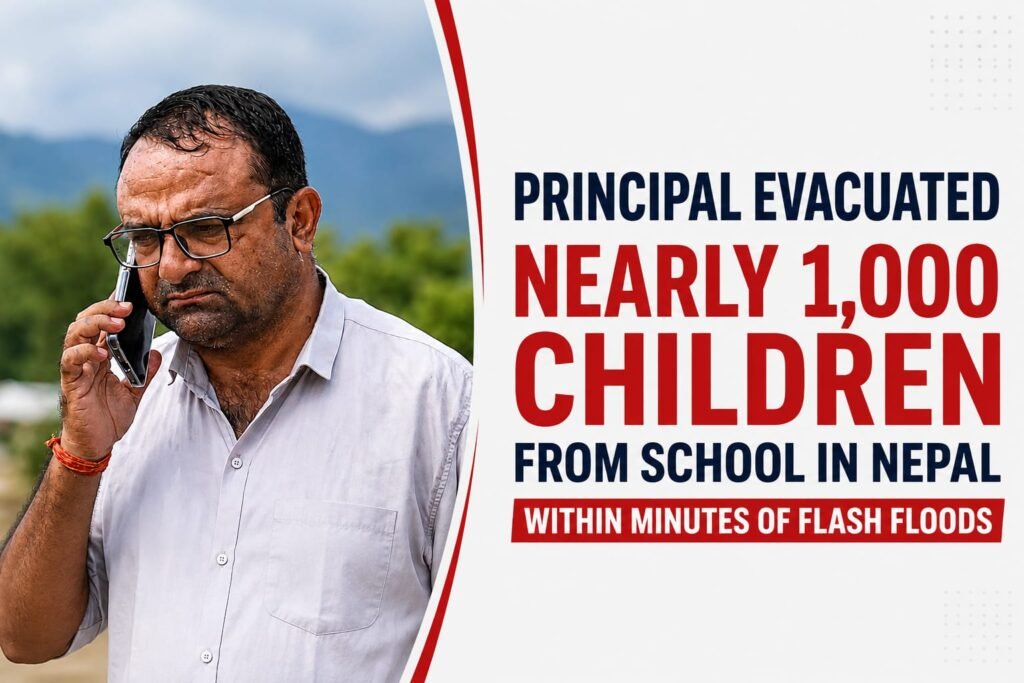
Principal Rajendra Dawadi acted quickly to move students to higher ground before the devastating flash flood reached the school.
A warning arrived at Tribhuvan Trishuli Secondary School just as classes were underway. Within minutes, principal Rajendra Dawadi made a decision that would become critical to the survival of hundreds of children.
On the morning of Aug. 26, Dawadi was teaching at the school in Nepal’s Nuwakot district when a colleague rushed in with news that a major flash flood was approaching. There was little time to debate what the warning meant or wait for the situation to become clearer.
Dawadi immediately ordered the students on campus to leave the school and move toward higher ground. Around 900 of the school’s 1,643 students were present that morning.
The decision came just minutes before floodwaters and debris swept through the area, destroying the school building.
A Warning That Could Not Be Ignored
For Dawadi, the choice was ultimately about taking a warning seriously even without knowing exactly how severe the approaching flood would be.
He later explained that ignoring the warning could have resulted in a devastating loss of life.
“I thought that even if the warning turned out to be wrong, the worst it would cost us was one day of study,” Dawadi recalled. “But taking it lightly could mean the loss of hundreds of lives.”
That calculation prompted him to act immediately.
Teachers began helping students leave the building and reach safer ground. Dawadi also contacted school bus drivers and told them to stay away from the school, preventing additional students from arriving while the danger was developing.
The evacuation was not a calm or organized school dismissal. Students were suddenly forced to leave their classrooms and make their way uphill as the threat approached.
Students Rushed Toward Higher Ground
For some students, the evacuation became a frightening race against time.
Yunisha Amatya, a 16-year-old student at Tribhuvan Trishuli Secondary School, remembered students trying to escape through a route behind the school. The ground was difficult to navigate, and classmates helped one another climb toward higher ground.
The crowd moving toward safety made the situation even more difficult.
Yunisha said she was worried that she could fall while climbing and credited the grip on her shoes with helping her stay on her feet. Other students also assisted one another as they struggled to reach a safer area.
Once she reached the hilltop, the emotional impact of what had happened quickly became clear.
Yunisha received a phone call from her father, who was crying. She recalled being so overwhelmed that she could not immediately speak.
For the students who made it out, the experience was not simply an evacuation. They had witnessed a disaster unfold with almost no warning and had watched their familiar school become engulfed by floodwaters.
The School Was Swept Away
After helping the students reach safety, Dawadi stood on a hillside and watched the flood destroy the school.
The loss carried an especially personal meaning for him. Dawadi had once been a student at the same school before eventually becoming its principal.
Years of memories were tied to the building, making it painful to watch it disappear.
“I am extremely emotional to see the school completely swept away,” Dawadi said. “The school holds so many memories for me.”
Two teachers who were unable to reach safety were also reported missing following the disaster.
The destruction left the school community facing the difficult task of rebuilding while also dealing with the emotional aftermath of the flood.
One Decision Changed the Outcome
The speed of Dawadi’s response stands out because the warning came with so little time to spare.
Had school officials waited to confirm the threat, hundreds of students could have remained inside the building when the flood arrived.
Instead, the students had already been moved toward higher ground.
Dawadi later reflected on how narrow the margin had been, saying that a delay of around 10 minutes could have changed everything.
“If we didn’t make a quick decision, if it was 10 minutes later, we all — including the students and me — wouldn’t be able to speak to you today,” he recalled.
His decision also extended beyond the students already at school. By contacting bus drivers and telling them not to approach the campus, he helped prevent more children from entering an area that was rapidly becoming dangerous.
Nepal Faces a Devastating Flood Disaster
The destruction of the school occurred as severe flooding affected communities near the Nepal-China border.
The disaster has caused widespread destruction, with homes, roads, bridges and other infrastructure damaged or swept away. Hundreds of people have died, while thousands more have remained missing as rescue and recovery operations continue.
The disaster has also affected schools and children across the region. The destruction of Tribhuvan Trishuli Secondary School means students who survived the flood now face uncertainty about where and when they will return to their education.
For families in affected communities, rebuilding will involve much more than replacing buildings. Many people have lost homes and possessions, while others are still searching for missing relatives.
The scale of the disaster has placed enormous pressure on rescue teams and local communities.
A School Principal Becomes a Symbol of Quick Action
Dawadi did not know when he ordered the evacuation that the school would soon be destroyed.
He simply had to decide whether the warning was serious enough to justify sending hundreds of students away from their classrooms.
He chose to act.
That decision gave approximately 900 children the opportunity to reach higher ground before the floodwaters overwhelmed the school. The building itself could not be saved, but the people inside it had a chance to escape.
For Dawadi, the experience has left behind both grief and relief. He lost a school that had been part of his own life since childhood, but he also witnessed the survival of hundreds of students entrusted to his care.
The story is a powerful reminder that during a rapidly developing natural disaster, acting on an early warning can sometimes matter more than waiting for complete certainty.
In this case, a few minutes made an extraordinary difference.