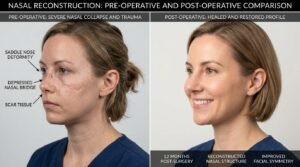

The Viral Revelation: A Harrowing Journey from Addiction to Anatomical Reconstruction
In a powerful and deeply vulnerable display of human resilience, Kelly Kozyra has captured global attention by documenting her extraordinary physical and emotional recovery following years of devastating substance abuse. Sharing her story across digital platforms including TikTok, Kelly laid bare the horrifying anatomical destruction caused by a grueling 19-month period of heavy, daily cocaine consumption. The illicit drug, known in medical science as a potent vasoconstrictor, severely starved her delicate nasal tissues of vital oxygenated blood, leading to progressive tissue necrosis, complete septal perforation, and ultimately the catastrophic structural collapse of her nose. What was once a youthful, symmetrical facial profile transformed into a collapsed ‘saddle nose’ deformity, robbing her not only of her airway function and sense of smell, but of her self-esteem and identity.
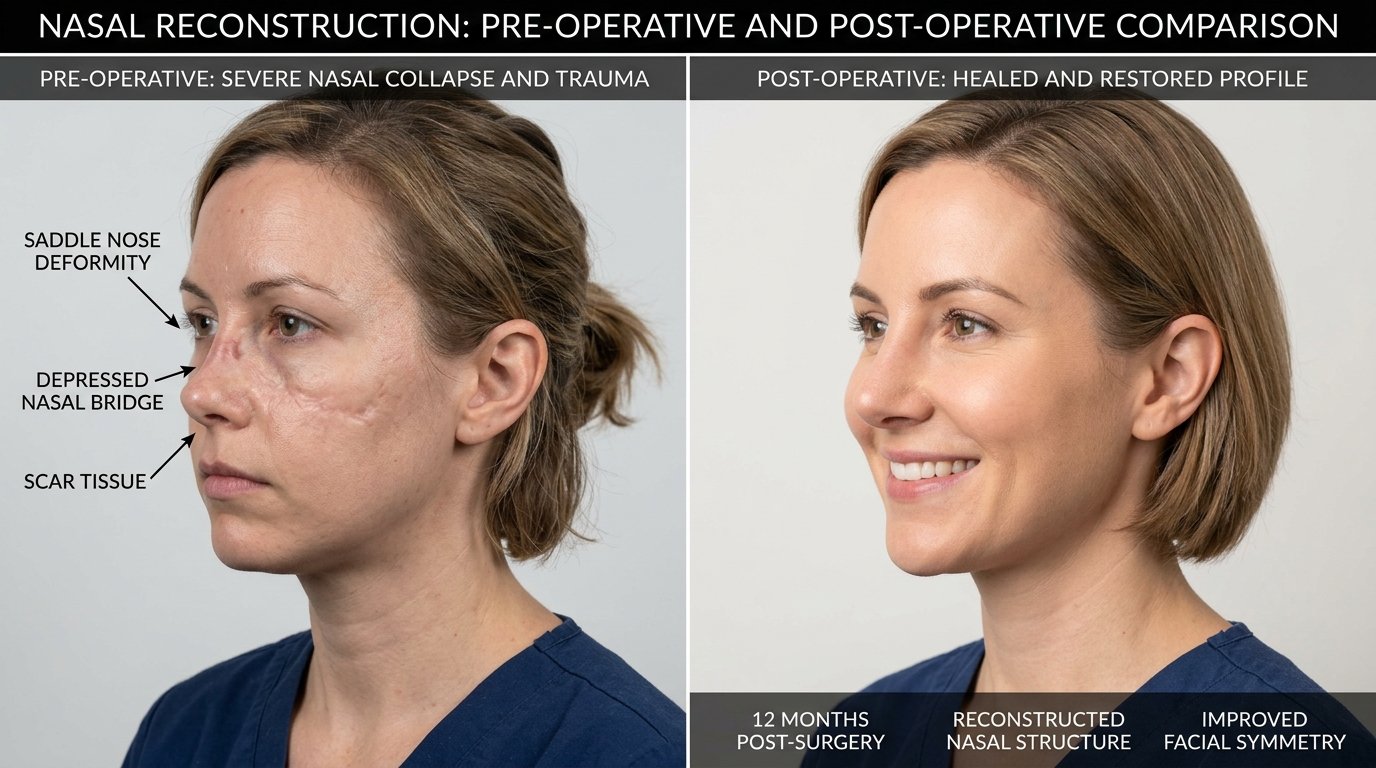
However, Kelly’s story did not end in despair; rather, it blossomed into one of the most astonishing modern medical miracles shared on social media. After achieving total sobriety in 2021, she embarked on an arduous, multi-year surgical journey comprising approximately 15 complex operations directed by elite reconstructive plastic surgeons. Central to her miraculous physical rehabilitation was a sophisticated surgical technique known as the paramedian forehead flap—an intricate procedure where skin, subcutaneous tissue, and blood vessels from the forehead are rotated downward to biologically regrow and resurface a brand-new nose. Kelly’s before-and-after reveals have stunned millions of viewers worldwide, serving not merely as a jaw-dropping aesthetic transformation, but as an urgent public health warning regarding the catastrophic, hidden physical perils of chronic cocaine dependency.
The Pathology of Cocaine-Induced Midline Destructive Lesions (CIMDL)
To comprehend why Kelly required such extensive craniofacial reconstruction, it is necessary to examine the severe physiological devastation that cocaine inflicts upon the human respiratory tract. When cocaine hydrochloride is snorted intranasally, it triggers immediate and profound vasoconstriction—the extreme narrowing of microscopic blood vessels throughout the mucous membranes. While recreational users seek the chemical’s transient euphoric high, the physiological consequence is localized ischemia, where delicate cartilage and vascular linings are completely deprived of oxygen. With chronic, habitual consumption, this persistent lack of microcirculation causes the mucosa to ulcerate, leading to tissue death, bacterial colonization, and the eventual disintegration of the quadrangular septal cartilage that supports the bridge of the nose.
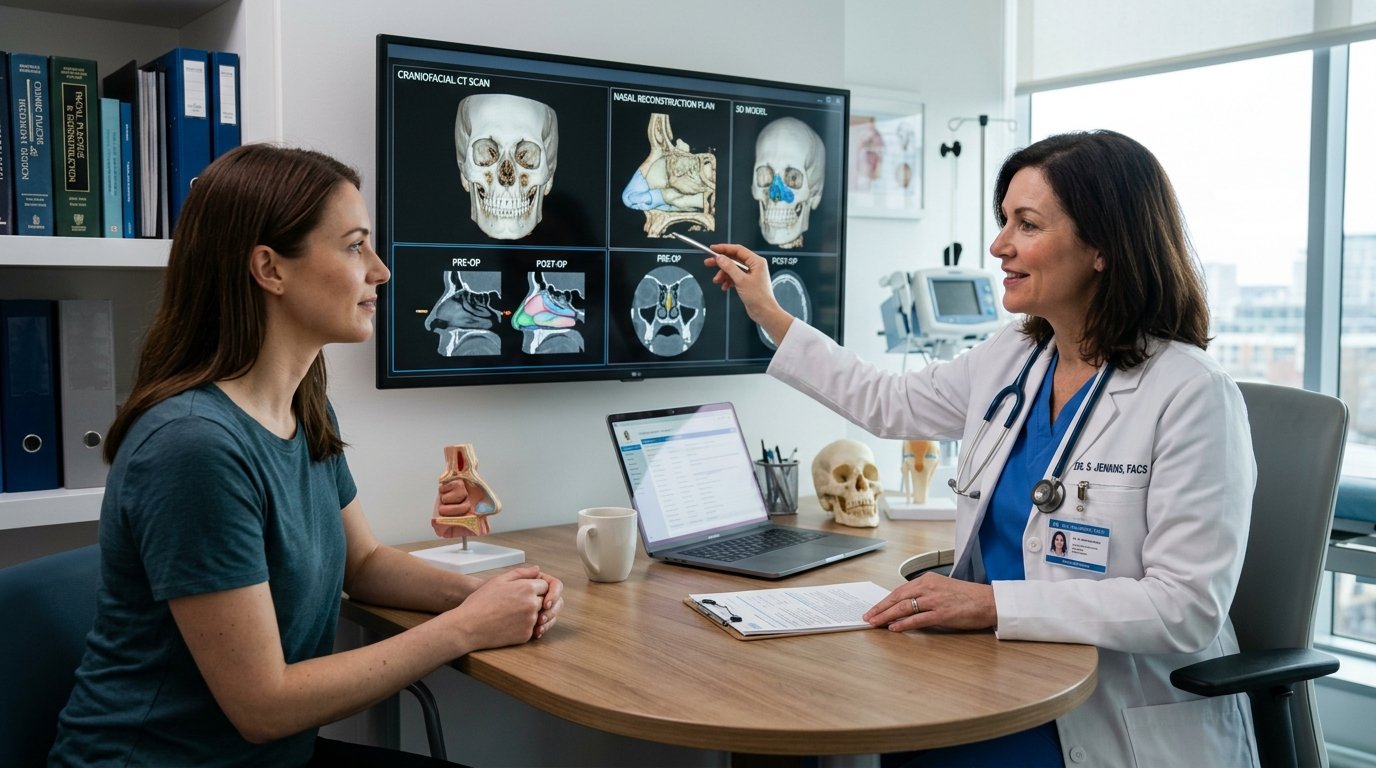
In medical literature, this aggressive degradation is classified under Cocaine-Induced Midline Destructive Lesions (CIMDL), an obliterative condition that can erode through nasal bones, perforate the hard palate into the oral cavity, and dissolve lateral nasal sidewalls. For Kelly, the damage extended far beyond cosmetic flattening; her entire internal nasal framework collapsed inward, causing severe chronic breathing obstruction, recurrent infections, painful crusting, and total loss of olfaction. Reconstructive surgeons routinely describe CIMDL as one of the most formidable challenges in plastic surgery, because the surrounding facial tissues are frequently compromised, scarred, and devoid of reliable vascular networks, rendering traditional minor cosmetic rhinoplasty completely futile.
The Paramedian Forehead Flap: Ancient Surgical Genius Perfected by Modern Science
Faced with total nasal collapse and the absence of viable local tissue, Kelly’s surgical team turned to the gold standard of subtotal and total nasal reconstruction: the paramedian forehead flap. While the procedure sounds like modern science fiction, its foundational principles date back thousands of years to the ancient Indian physician Sushruta, often revered as the father of plastic surgery, who utilized forehead skin rotations to reconstruct amputated noses in 600 BCE. In contemporary craniofacial surgery, the technique has been refined into an exquisite, multi-stage microvascular art form designed to replicate the complex multi-layered architecture of the human nose, which requires an inner mucosal lining, a rigid structural framework of bone or cartilage, and an outer skin envelope matching the facial color and texture.
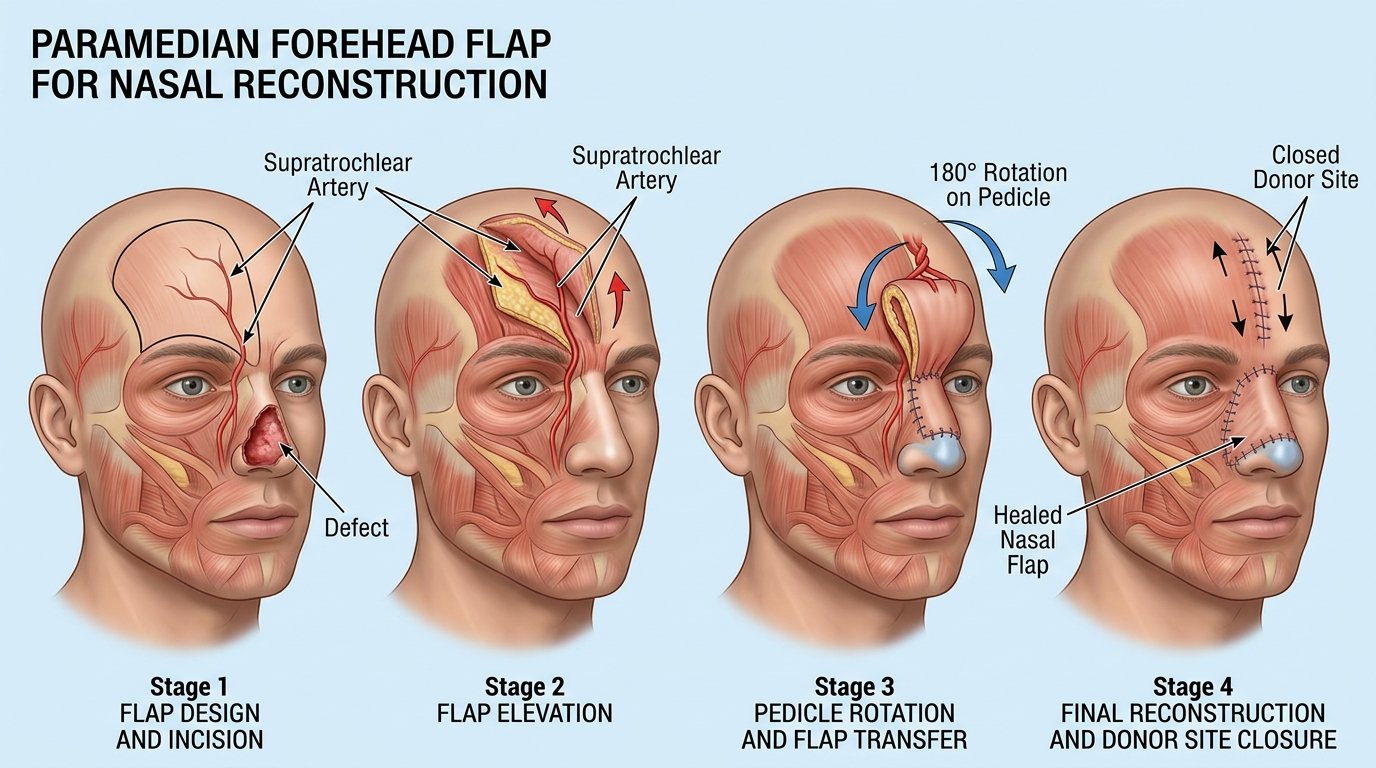
The surgical protocol hinges upon the supratrochlear artery, an extraordinarily reliable blood vessel located near the inner corner of the eyebrow that travels vertically up the forehead. During the primary stage, surgeons map out a precise template corresponding to the patient’s missing nasal skin, incise a paddle of forehead tissue, and elevate it while keeping its base—the vascular pedicle—firmly attached to the brow. This tissue is then rotated 180 degrees downward like a living hinge and meticulously sutured over the reconstructed nasal framework. Because the flap remains anchored to its native blood supply via the open pedicle bridge, the newly transferred tissue receives constant arterial perfusion and venous drainage, allowing it to take root, survive, and integrate into the midface over several weeks before the pedicle is safely severed in subsequent refinement operations.
Beyond the Forehead: Microvascular Free Flaps and Multi-Stage Cartilage Grafting
Because the internal vascular bed of Kelly’s nasal cavity had been utterly obliterated by prolonged drug exposure, the paramedian forehead flap alone could not provide sufficient tissue bulk or internal lining. To establish a robust foundation, her surgical team performed a complex microvascular tissue transfer, harvesting a radial forearm free flap—a composite graft of skin, subcutaneous tissue, and radial blood vessels extracted from her left arm. Under high-powered surgical microscopes, microvascular surgeons performed delicate micro-anastomoses, connecting microscopic arteries and veins from her arm tissue to the facial vessels in her cheek and neck, establishing a newly supercharged circulatory network to sustain the reconstructive site.
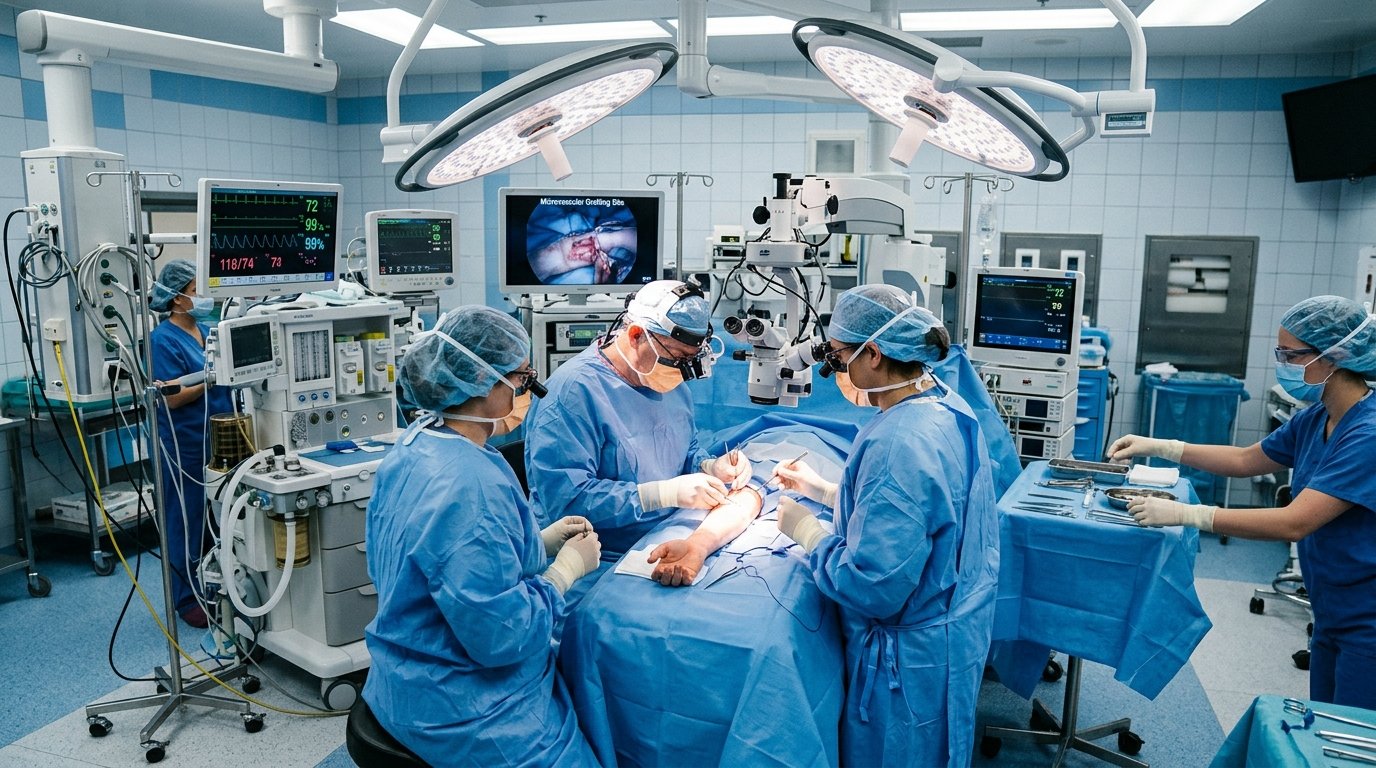
Furthermore, reconstructing the three-dimensional architecture of the nose required rebuilding the rigid skeletal framework. To achieve this, surgeons harvested autologous cartilage grafts—frequently taken from the patient’s costal rib cage and auricular ear cartilage—carving them into structural struts, spreader grafts, and alar batten plates to recreate the dorsal nasal bridge and nostril contours. Over the course of approximately 15 independent operations spread across multiple years, surgeons performed meticulous thinning, debulking, scar revisions, and laser treatments. Each successive procedure sculpted the transplanted forehead and forearm tissues into a refined, harmonious nasal structure capable of supporting natural airflow while seamlessly blending into her natural facial aesthetics.
Vulnerability as Power: Documenting Recovery and Smashing Stigmas on TikTok
Undergoing extensive facial reconstructive surgery is an immensely taxing psychological ordeal. During the intermediate stages of a forehead flap procedure, patients must live for weeks or months with a prominent, pedicled skin bridge extending from their eyebrow to their nose, often accompanied by open surgical sutures, swelling, and bulky medical dressings. For many individuals, this temporary disfigurement leads to acute social anxiety and self-imposed isolation. Kelly, however, made the courageous decision to do the exact opposite: she turned on her smartphone camera, opened TikTok, and documented every unfiltered step of her clinical journey for the world to see.

Her transparent videos showcased the unvarnished realities of post-operative healing—from the initial bulky, medicated dressings and arm donor incisions to the gradual thinning of the graft and the eventual restoration of her facial symmetry. In her commentary, Kelly openly shared her past mistakes, shedding tears over the pain of addiction while answering curious followers’ medical questions with radical honesty and grace. By dismantling the pervasive shame and secrecy that surround both substance use disorders and visible facial reconstruction, Kelly created an empowering digital sanctuary where empathy, medical education, and accountability replaced judgment, inspiring tens of thousands of viewers battling their own hidden dependencies to seek professional help.
The Triumph of Sobriety: Reclaiming Health, Identity, and Second Chances
Today, Kelly Kozyra stands as a radiant testament to what is possible when medical brilliance converges with unrelenting personal determination. Years removed from the depths of active addiction, her reconstructed nose has settled into a natural, beautifully contoured shape that harmonizes perfectly with her features, while her forehead and forearm donor sites have softened into faint, honorable battle scars. More importantly, the internal surgical repair restored her fundamental ability to breathe freely, exercise, and experience the world without chronic pain or debilitating airway blockages. Her transformation represents far more than an impressive cosmetic feat; it symbolizes the physical reclamation of a life once surrendered to chemical dependency.

Reflecting upon her transformative journey, Kelly frequently reminds her growing international audience that aesthetic restoration is only the outward manifestation of a much deeper, internal healing process. True recovery, she emphasizes, begins in the mind and soul—choosing sobriety each day, cultivating supportive relationships, and forgiving oneself for the past. Her viral presence serves as an unshakeable beacon of hope for anyone trapped in the grip of addiction, proving that no matter how catastrophic the physical or emotional damage may appear, redemption, healing, and a vibrant future are always within reach.
The Broader Impact: Raising Awareness Against the Rising Epidemic of Drug-Induced Facial Damage
Medical experts in otolaryngology and facial plastic surgery have widely commended Kelly for bringing public awareness to an issue that is increasingly documented in emergency departments and ENT clinics worldwide. As illicit drug supplies are routinely adulterated with harsh cutting agents such as levamisole—a veterinary anti-parasitic known to cause severe vasculitis and skin necrosis—the prevalence of severe facial deformities among substance users has escalated dramatically. Public educational campaigns often emphasize internal organ damage such as heart attacks or liver failure, but rarely highlight the rapid, irreversible facial disfigurement that can occur from nasal inhalation.
By transforming her personal trauma into an open, educational platform, Kelly has pulled back the curtain on a taboo medical reality, demystifying complex craniofacial surgery while saving prospective lives. Her viral transformation illustrates that behind every striking before-and-after photo is a human story of courage, surgical artistry, and the profound grace of second chances. As her story continues to circulate across global media, Kelly Kozyra’s enduring legacy will remain that of a survivor who refused to let addiction dictate her destiny, inspiring millions to embrace hope and seek healing against all odds.
Frequently Asked Questions About the Forehead Flap Nasal Reconstruction
What is a ‘forehead flap’ procedure and how does it regrow a nose?
A paramedian forehead flap is a specialized reconstructive surgery used to repair severe, full-thickness nasal defects. During the procedure, a surgeon designs a flap of skin and subcutaneous tissue on the forehead based on the supratrochlear artery, which supplies oxygenated blood. The tissue is elevated and rotated 180 degrees downward to cover and rebuild the nasal framework while remaining temporarily attached to the brow via a vascular pedicle. Once the new nasal tissue establishes its own independent blood supply from surrounding facial vessels—usually after three to four weeks—the pedicle is divided and surgically contoured.
How does chronic cocaine use lead to the total collapse of the nose?
Cocaine is a powerful vasoconstrictor, meaning it causes intense, prolonged constriction of microvascular blood vessels supplying the nasal mucosa and cartilage. With chronic, frequent snorting, this persistent lack of blood flow causes ischemic necrosis (tissue death) of the nasal septum. Without blood and oxygen, the cartilage deteriorates, forming large perforations that eventually destroy the structural support of the midface, resulting in a condition known as saddle nose deformity or Cocaine-Induced Midline Destructive Lesions (CIMDL).
How many surgeries are typically required for total nasal reconstruction?
Reconstructing a collapsed nose from severe chemical or traumatic damage rarely occurs in a single operation. In complex cases like Kelly Kozyra’s, patients often undergo between 10 to 15 surgical procedures spread over several years. These stages include preparatory tissue debridement, microvascular free tissue transfers (such as harvesting radial forearm tissue for internal lining), autologous rib or ear cartilage harvesting for skeletal framework support, the primary forehead flap transfer, pedicle division, and multiple subsequent thinning and laser scar revision surgeries.
Can a patient breathe normally after undergoing a forehead flap reconstruction?
Yes. A primary objective of comprehensive nasal reconstruction is not merely cosmetic appearance, but functional airway restoration. Surgeons meticulously reconstruct the internal nasal valves and patent nasal passages using rigid cartilage batten and spreader grafts to prevent the airway from collapsing during inhalation. While swelling can temporarily restrict airflow during early post-operative stages, completed reconstructions provide substantial, long-term improvements in nasal breathing and quality of life.
What advice do medical professionals and survivors share regarding recovery?
Medical professionals and survivors emphasize that total, sustained sobriety is an absolute prerequisite prior to undergoing reconstructive surgery, as any ongoing drug use will compromise blood flow and cause the transplanted tissue grafts to fail catastrophically. Additionally, survivors like Kelly stress the importance of mental health therapy, patience during intermediate healing stages when facial bandages are visible, and maintaining hope, emphasizing that the multi-stage surgical journey requires profound emotional resilience.