

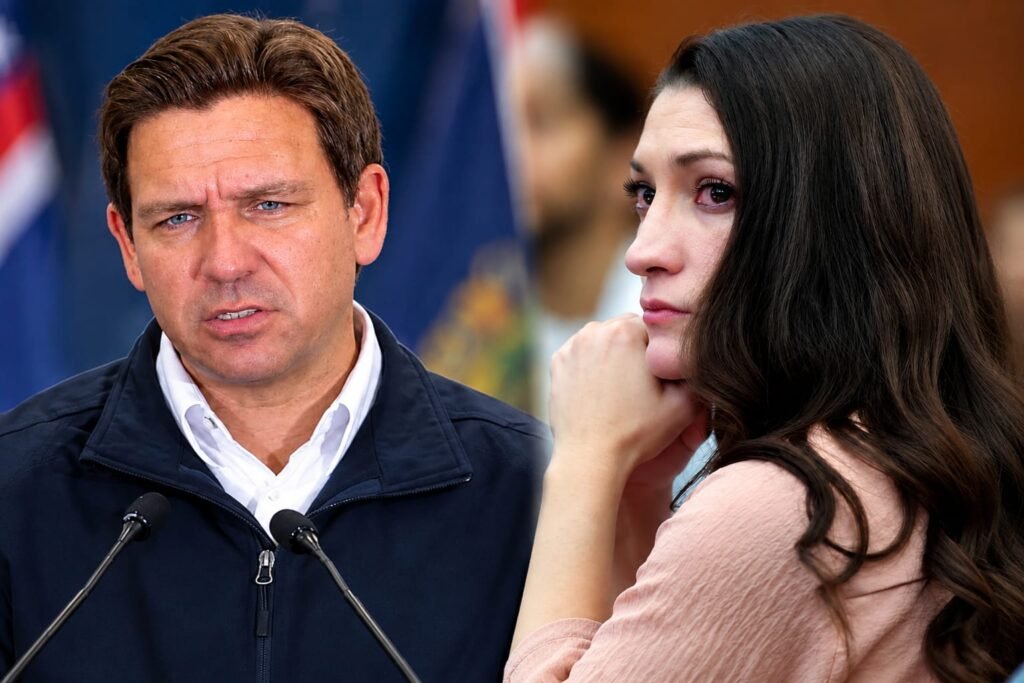
Ron DeSantis offers Florida “asylum” to the lone holdout juror in the Lindsay Clancy trial.
Florida Gov. Ron DeSantis has offered to provide “asylum” to the lone holdout juror whose refusal to join the rest of the panel led to a mistrial in Lindsay Clancy’s high-profile Massachusetts murder case.
DeSantis made the comment on social media after NBC10 Boston reported that the unidentified juror had faced domestic violence allegations and was subject to an active restraining order. The governor accused the network of attempting to discredit the juror and argued that his identity should remain protected.
“A man objected to allowing a woman to kill her three young kids and get away with it, so NBC is trying to smear that juror, whose identity should be protected,” DeSantis wrote on X. “If the juror is being harassed, Florida will provide asylum — I’m sure he’d be welcomed and appreciated.”
The comments came as questions continued to surround the jury’s selection process and the events inside the deliberation room.
Why the Lindsay Clancy Trial Ended Without a Verdict
Clancy’s trial ended in a mistrial on Sept. 4 after jurors could not reach a unanimous decision about whether she was criminally responsible for the deaths of her three children.
The 36-year-old former labor and delivery nurse had pleaded not guilty by reason of lack of criminal responsibility. She acknowledged killing her children but argued through her defense that she was experiencing postpartum psychosis and was not legally responsible for her actions at the time.
The children—Cora, 5, Dawson, 3, and Callan, 8 months—were killed at the family’s home in Duxbury, Massachusetts, in January 2023.
After more than six days of deliberations, the jury remained divided. The panel reportedly stood at 11-1, with one juror refusing to support a verdict finding Clancy not guilty by reason of insanity. Judge William Sullivan declared a mistrial after the jury reported multiple times that it could not reach an agreement.
The case has drawn national attention because of the legal questions surrounding postpartum psychosis, psychiatric treatment and criminal responsibility.
Jurors Describe Tense Deliberations
In interviews with NBC10 Boston after the mistrial, three jurors—including the foreperson—described a difficult deliberation process.
Foreperson Roni Carlson said the holdout juror acknowledged having reasonable doubt about Clancy’s guilt but still refused to vote for a verdict of not guilty by reason of insanity. Carlson said she began filling out the verdict forms after hearing the juror express doubt, only to stop when he said he would not support the acquittal.
The jurors also criticized the holdout’s conduct during discussions. One described him as “arrogant,” while others said he did not appear willing to engage meaningfully with the evidence or arguments presented by the rest of the panel.
The holdout juror has not publicly provided his own account of the deliberations. His name has been withheld, and NBC10 Boston reported that attempts had been made to contact him.
The legal significance of the jurors’ statements remains a matter for the court. A juror’s disagreement, even when controversial, does not automatically establish misconduct or prove that the person violated the judge’s instructions.
Report Raises Questions About the Juror’s Background
The controversy intensified after NBC10 Boston reported that the holdout juror had a history of domestic violence allegations.
According to the report, he was charged in 2021 after his teenage nephew allegedly told police that he saw the man grab his then-wife by the throat and throw her against a dresser. The charge was later dismissed.
The juror’s former wife reportedly said she chose not to pursue the case because she feared that testifying could affect her custody of their daughter. Those statements describe allegations and concerns surrounding the case, not a criminal conviction.
NBC10 also reported that the same nephew obtained a restraining order against the juror in 2025. The nephew allegedly accused him of pushing him to the ground and repeatedly punching him in the face.
The reports have prompted questions about whether the juror accurately answered the screening questions required of Massachusetts jurors.
What Jury Selection Questions May Have Covered
NBC10 Boston reported that Massachusetts juror questionnaires ask prospective jurors whether they have been arrested, charged with a crime or served with a court order.
If the reported allegations and restraining order were known to the juror, he would have been expected to answer those questions accurately during the selection process.
However, the available reporting does not establish whether he disclosed the information, how he answered the questionnaire or whether court officials had independently reviewed the records before selecting him.
Those details could become important if the defense seeks to challenge the mistrial or argues that the jury was improperly constituted.
The existence of an allegation or restraining order alone also does not establish that a person is legally disqualified from jury service. The relevant issue would include what information was disclosed, what the court knew and whether any omission materially affected the proceedings.
DeSantis Criticizes the Media Coverage
DeSantis’ response focused on the public scrutiny directed at the unidentified juror.
The Republican governor framed the juror’s position as opposition to allowing Clancy to avoid responsibility for killing her children. He also objected to the juror’s identity being investigated or discussed publicly.
His offer of “asylum” in Florida appeared to be a political statement rather than a formal legal proposal. DeSantis did not announce any specific state program or legal process for relocating the juror.
The governor’s comments came amid broader criticism of media coverage surrounding the case. The identity of the holdout has remained protected, while details about his background have emerged through reporting and interviews with people familiar with the allegations.
Clancy’s Defense Focused on Postpartum Psychosis
At trial, Clancy’s defense argued that she was suffering from postpartum psychosis when she killed her children.
The condition is a serious psychiatric emergency that can occur after childbirth and may involve hallucinations, delusions, confusion or a break from reality. The defense argued that Clancy’s mental state, combined with medication and other factors, prevented her from understanding or controlling her actions.
Prosecutors, however, argued that Clancy should be held criminally responsible for the killings.
The case did not center only on whether Clancy committed the acts. She admitted killing the children. The central legal question was whether she met the Massachusetts standard for a lack of criminal responsibility at the time.
That distinction explains why the jury’s disagreement over the insanity defense was enough to prevent a final verdict.
What Happens Next in the Case?
The prosecution has not publicly announced whether it will seek a retrial.
A follow-up hearing is scheduled for Sept. 29, when the court is expected to address the next stage of the case. Clancy’s attorney, Kevin Reddington, has argued for relief following the mistrial and has challenged aspects of the proceedings, including the handling of the holdout juror.
A retrial remains possible, but the final outcome will depend on future court decisions and whether prosecutors choose to proceed.
Meanwhile, Clancy remains in a psychiatric facility after surviving an apparent suicide attempt following the deaths of her children. The attempt left her paralyzed from the waist down.
The Case Continues to Raise Legal and Mental-Health Questions
The controversy surrounding DeSantis’ comments is only one part of a much larger legal dispute.
The trial brought renewed attention to postpartum psychosis, the treatment of mothers experiencing psychiatric crises and the difficult standards courts use when evaluating criminal responsibility.
The mistrial also raised questions about juror screening, privacy and the limits of public discussion about jurors after a high-profile case ends without a verdict.
For now, the holdout juror’s identity remains protected, and the allegations about his personal history have not been resolved through a public criminal finding. The court’s next decisions will determine whether the Lindsay Clancy case proceeds to another trial or takes a different legal path.